
Anarchists, union activists, Indigenous organizers, and disgruntled Trumpists find themselves side by side in the fight.
By Paul Messersmith-Glavin, Truthout
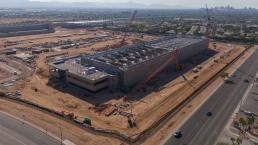
Between 4,000 and 5,000 data centers are actively humming in the U.S. right now, draining energy and, in the case of some of the hyperscale ones, consuming as much as 5 million gallons of water per day. Even this does not satisfy the demand cultivated by the tech industry, however: At least 3,000 more data centers are under construction or planned, prompting a diverse grassroots mobilization against their construction.
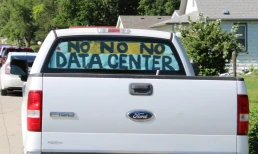
Indigenous people are resisting continued attempts to exploit their land, air, and water. Rural white folks, some of whom voted for Donald Trump, are now going door to door, outraged about rising electricity costs and water shortages.
Opposition to data centers has put labor unions in motion, with the Graduate Employees’ Organization at the University of Michigan using the slogan “AI is not inevitable,” seeing artificial intelligence as a dystopian force made possible through data centers. These efforts represent the front line in the struggle against attempts by high-tech billionaires to create a dismal world in which they hold all the power and the rest of us serve their interests.
Honor the Earth
“There’s this big techno-feudal battle happening right now. We’re watching an Empire crumble, right?” Krystal Two Bulls, an Oglala Lakota/Northern Cheyenne anti-data center organizer with the activist group Honor the Earth, told me. “Technology is the last frontier, and whoever has the most advanced generative AI has the power at this moment.”
Native Americans are some of those leading the organizing against data centers, from Virginia and upstate New York, though Montana, the Dakotas, Arizona, and Oregon. According to Honor the Earth, a national Indigenous sovereignty organization, there are currently at least 106 data centers being proposed on or near Native land.
Data centers are the material constructs enabling the perpetuation of large language models (LLMs), commonly referred to as a form of “intelligence.” LLMs aggregate knowledge and then generate information based upon processing and sorting huge inputs of words, but despite advances in their ability to differentiate between believable scenarios and nonsense, in most ways the algorithm still operates linguistically rather than conceptually. It’s not smart, it’s just massive.
Developed within the framework of capitalism, artificial intelligence threatens human civilization in several ways. In addition to its use by corporations to rapidly replace human labor — both blue-collar assembly line and white-collar administrative positions — there are genuine fears by many involved in its development that AI might someday not only take human jobs, but also lead to the mass destabilization of human societies, increasingly repressive surveillance regimes, or in the most alarmist imaginings, even an existential risk to human survival. Future killing machines like something from the Terminator films aside, AI is already being used to choose targets — and this process has resulted in the murder of Iranian school children and people in Gaza.
As Krystal Two Bulls argues:
Generative AI is being used to surveil citizens, violating our right to privacy, and then that is being turned around and used for military purposes. We can see the connection directly to violence. As Native peoples we honor the Earth, which is why it is so important to resist the construction of these data centers and the entirety of the AI infrastructure.
Looking at the global context in which AI is being developed, these construction projects drive us further from an adequate response to the climate crisis. We have known for several decades that continuing to burn fossil fuels will destroy the unique climate that supports human flourishing on Earth. It is imperative that we stop extracting and burning them, yet with Trump’s return to power and Republicans in both chambers of Congress, what little progress was made in the U.S. is being reversed. This is happening at the very moment we are approaching various climate tipping points, accelerating climate collapse.
For the last 20 years, the Tonawanda Seneca Nation in western New York has resisted industrial development at the site of the Science, Technology and Advanced Manufacturing Park (STAMP). The 1,250-acre sprawling site is located next to Big Woods, a natural area of cultural and practical significance for the Seneca Nation, as well as a federal and state-recognized wildlife refuge. The nearby white settlement effort to site a data center here led the Seneca Nation’s chiefs’ council to ask Grandell “Bird” Hallett Logan — the community language resource coordinator at the reservation — to be the spokesperson for the Seneca Nation. Logan told me that the organizing began with Native people from his community, but in time, a group developed called the Allies of the Tonawanda Seneca Nation, bringing together people from the Seneca Nation with those from the non-Native community elsewhere in the state.
According to the Sierra Club, a nondisclosure agreement signed by the Genesee County Development Center prevents the community from even knowing which tech giant the data center would serve. Before work can begin on the site, the planning board of the local town of Alabama, New York, has to approve the project, and it must receive a state environmental review, opening up several avenues to stop it. In addition, the data center’s opponents are also considering a lawsuit, which could delay or prevent its construction entirely.
Logan explained how they are organizing: “Much of our messaging is about how our customs and usage are at risk due to environmental harm. We worry that this noise pollution from a data center would cause the animals nearby to flee.” Discussing the support that the Allies of the Tonawanda Seneca Nation have received from the surrounding non-Native community, Logan said, “Some people are supportive of us because they see how their county, their state, is acting in ways that continue to harm our customs, and they’d prefer that their government not take part in such actions.”
Los Alamos National Lab Data Center
Los Alamos National Laboratory, founded in 1943 for the Manhattan Project and instrumental in the development of the first atomic bombs, is planning to build a $1.25 billion data center on acreage that the University of Michigan, which is based in Ann Arbor, purchased nearby in Ypsilanti Township. Workers at the university, some of whom previously did Palestine solidarity work and organized around how AI is affecting teaching, have now taken up the struggle to stop the data center.
Nathan Kim, a member of the University of Michigan Graduate Employees’ Union who previously helped run workshops like an AI “Workers’ Inquiry,” told me that he found the opposition against the data center in the surrounding community inspiring, bringing campus union workers into coalition with people living near the campus. This “shifted how I thought about politics — it wasn’t the case that everything was hopeless, but instead that people would continue to fight back, and always would,” Kim said.
People across the U.S. are in motion against data center construction. As Kim observes, “The reality of this issue being mobilizing in new and interesting ways meant that many people were angry, but few people saw themselves as leaders from the outset.”
This is common when social or environmental issues impact local communities. One can think of the people affected by contaminated drinking water in Flint, Michigan, or those impacted by toxic waste in the Love Canal neighborhood of Niagara Falls, New York. People experience anger and anxiety, often followed by frustration over their interactions with local officials. With regard to data centers, Kim said: “People seem to have a built-up resentment and hatred of Big Tech that data centers have become an outlet for. It’s about utilities and humming noises and water usage, definitely, but even more so it is about the way Big Tech has continually extracted with no punishment.”
What is noteworthy about how people are organizing against data centers in this part of Michigan is the utilization of the type of horizontal structures that came out of the anti-authoritarian organizing of the anti-globalization movement at the turn of the century and the subsequent Occupy movement.
As Samantha Stewart, who lives in Ypsilanti Township and is involved in the struggle against the data center, says about the campaign, “It’s designed with a spokescouncil style, so there are a million working groups (literally I know of 17 that meet regularly) all doing what makes sense to them to stop the data center.”
In a traditional spokescouncil model, smaller affinity groups and working groups send delegates to a spokescouncil to make decisions. “There are big monthly meetings where everyone comes together, they always have food and child care. No one is in charge; each working group does what it wants to stop the data center,” Stewart explained, adding that what holds this free-wheeling assembly together are “some small working agreements, just that we don’t condemn each other publicly … and that we don’t collaborate with police in the prosecution of each other.”
Organizing against data centers in Michigan has brought together people with many types of backgrounds. “Ypsilanti is more working-class with a very active anarchist movement … But the fight against data centers in Michigan as a whole is very diverse,” Kim points out. For example, he said he went to an organizing “meetup once in Augusta housed in a barn that was a U of M football watch party room and had ‘Faith, Family, Freedom’ dangling over the door.” Kim says, in his organizing work, that “encounters are somewhat frequent” with Trump supporters. But, as Stewart points out, “The campaign has been so welcoming!”
Stewart added:
People hate the data centers for all sorts of reasons! The serious negative health consequences are really concerning to a lot of people. People are worried about increased bills and the destruction of our beloved park. Lots of people are against escalating war, and really worry about [associating with labs known for] developing nuclear weapons, or that we will be a military target based on this facility.
Stewart said that when she has “gone out knocking on doors, there have been a ton of folks with Trump yard signs who absolutely hate the data center. The Republicans struggle because they mostly don’t have organizing experience and aren’t sure how to get things done together.”
Trying to stop the data center has brought these disparate groups together. “We are a multiracial and very trans organizing group, so we don’t gel super well with them, but they do their own stuff and we do coordinate,” Stewart said.
Addressing the diverse nature of data center opposition in Michigan, Kim said: “I see the left’s job today to understand the kernel of truth at the heart of each Trump voter’s beliefs,” and then to “identify how that can be met with a transformative socialist vision where we take care of each other, can have our basic necessities met, and stand for peace.”
Trump Coalition Fissures
The tech and fossil fuel industries are two of the biggest sections of the ruling class backing Trump and the current transformation of the U.S. into a more openly authoritarian state. But fissures are starting to open up within sections of the grassroots MAGA movement. First, Steve Bannon and other MAGA activists expressed their racist, anti-immigrant opposition to Big Tech’s desire to grant visas to highly skilled workers. MAGA members have also expressed dissent for the U.S.-Israeli war against Iran, as well as the broader U.S. policy of providing Israel with financial and military support, including throughout its genocide of Palestinians and its war on Lebanon. Now many people who voted for Trump several times are opposing the construction in their communities of the tech industry’s sacred data centers.
As Indigenous people, union organizers, and those on the left come into contact with these disgruntled Trumpists, the opportunity exists to develop mutual understandings. Perhaps these encounters will widen the worldview of those who follow Trump and who are hostile to other working people, including those who have recently arrived in the U.S. looking for a better life.
The process of widening a person’s worldview entails hard discussions. If we approach these with a strong understanding of the material grievances that draw people toward Trumpism, we can use the space of the emerging, imperfect coalitions against the data centers to create openings to redirect anger away from scapegoats and toward the systems of power driving ecological destruction, exploitation, and war. This presents an opportunity to cultivate a unifying understanding of the role of class oppression and how to resist capitalist exploitation.
The struggle against data centers is but one front in the fight against rising authoritarianism and ecological collapse. It is an issue that resonates across political divides, opening opportunities, and potentially sparking a larger movement. Stewart has the necessary long-range perspective, saying: “I want to build trust and bravery across a broad group of people so that we are ready for the next thing we need to fight.”
Recent Posts

‘Stop The War on Iran’: Brooklyn Peace Activists Urge Jeffries to Help End Conflict
Take Action Now Democrats have a golden opportunity to capitalize on this issue, win big in November, and take real action on AI data centers to…

A Blue Wave Won’t Wash Away Our Oligarchy Problem
Take Action Now The massive election spending by Elon Musk and other billionaires is a huge problem, even if many of the superwealthy’s favorites…
Democrats Should Get Behind a National AI Data Center Moratorium
Take Action Now Democrats have a golden opportunity to capitalize on this issue, win big in November, and take real action on AI data centers to…

Another Way Out: Public Execution Is an Everyday Reality—Livestreamed or Not
Take Action Now For some, the Trump administration’s plan to livestream an execution was unacceptable because it wouldn’t happen behind closed doors……