
Russia’s brutal invasion complicates the left’s decadeslong effort to untangle Europe from the U.S.-led military alliance.
By Alice Speri, The Intercept
On a single day in the fall of 1983, some 400,000 people took to the streets across Belgium to protest nuclear proliferation and the North Atlantic Treaty Organization. The protest was one of scores of mass demonstrations in Western Europe amid an escalating Cold War, as citizens of NATO member countries called for an end to the military alliance and U.S. dominance in it. Twenty years later, when the U.S. invaded Iraq over the objections of several NATO allies, protesters in Europe and across the world numbered in the millions — one of the largest anti-war protests ever.
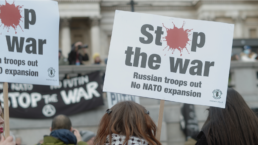
But when peace activists in Belgium called for a mobilization last month in the aftermath of Russia’s invasion of Ukraine and of the military aid that U.S. and European countries sent to Kyiv, the numbers were far smaller. It was the same elsewhere in Europe. While anti-war demonstrations in some countries were larger, they hardly compared to the mass mobilizations against the Iraq invasion.
“We had maybe three, 4,000 people, which is not many,” Ludo De Brabander, a member of Belgian peace group Vrede vzw, told The Intercept. “It was difficult to mobilize.”
“Iraq was very clear: It was an aggressive war based on false arguments,” he added. In Ukraine, by contrast, it was Russia that had staged an illegal, unprovoked invasion, and U.S.-led support to Ukraine was understood by many as crucial to stave off even worse atrocities than those the Russian military had already committed. That has left peace activists scrambling, said De Brabander, “because we don’t want to support NATO. And of course, we also oppose what Russia is doing. And a position in between, with alternatives to war, is very difficult to sell.”
As a result, the messaging at the European protests in March was at times confused and inconsistent: Some were filled with Ukrainian flags and explicitly in support of the Ukrainian people and their resistance. Others displayed the rainbow “peace” flag ubiquitous in Europe during the Iraq War and featured calls against increased military spending and the prospect of NATO expansion.
Recent Posts
The Pentagon Asked OpenAI for Artificial Intelligence Designed to Rarely Say No
Take Action Now The U.S. military’s desire for an AI tool with “minimal refusal rates” was revealed through a FOIA lawsuit filed by The Intercept.…
Real History: After 9/11, the ‘War on Terror’ Was a War of Terror
Take Action Now Through it all, the ongoing war effort that began in autumn 2001 had an implicit throughline in dominant media and politics: while…

Abolish the Board of Peace. Try the Table of Peace.
Take Action Now I asked people to pretend to be the United States Congress for 10 seconds. (Many of them were disgusted at the thought but I assured…
Black Power, White Heat, and the Work of Solidarity
Take Action Now What a history of the 1960s can teach us about organizing in an authoritarian ageBy Alexandria Shaner, Z Network There is a…