
The former congressman tells Robert Scheer that a provision buried in the 2027 National Defense Authorization Act could integrate the United States and Israel at the highest levels of military technology—without meaningful public debate or congressional scrutiny.
By Scheerpost
Former Congressman Dennis Kucinich has spent decades warning about the machinery of permanent war. But in a new conversation with Robert Scheer, he argues that Congress is now on the verge of crossing a line without precedent in American military history.
At the center of Kucinich’s warning is Section 219 of the 2027 National Defense Authorization Act, a provision he says would formally integrate key areas of U.S. and Israeli military development, including artificial intelligence, autonomous weapons, quantum sensing, cyber and electronic warfare, biotechnology, missile defense, drones and directed-energy systems.
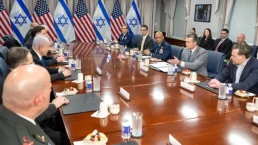
“They call it integration, but I call it a merger,” Kucinich tells Scheer.
The implications, he argues, go far beyond traditional military aid or weapons sales. Kucinich warns that the provision could create new counterintelligence risks, deepen U.S. dependence on Israel’s military infrastructure and technology, blur questions of war powers and further entangle Washington in Israel’s expanding regional conflicts.
Even more alarming, Kucinich says, is how little debate the proposal has received. Rather than being considered through a separate treaty or subjected to extensive congressional hearings, the provision has been folded into a massive defense authorization bill that lawmakers will face enormous political pressure to support.
“This provision has been smuggled into the bill,” Kucinich argues. “There’s never been any debate.”
For Scheer, the contradiction is impossible to ignore. At the moment the United States marks 250 years since declaring its independence, Washington may be moving toward an unprecedented military dependence on another state—one whose conduct in Gaza, the West Bank and Lebanon has placed it at the center of international accusations of genocide and grave violations of international law.
In this urgent edition of Scheer Intelligence, Scheer and Kucinich examine what Section 219 could mean for American sovereignty, constitutional government and the future of war—and why a provision of such consequence has received so little attention from Congress, the Democratic opposition and the mainstream press.
The Secret U.S.-Israel Military Merger Hidden in Congress’ $1.5 Trillion War Bill
“They call it integration, but I call it a merger,” Kucinich tells Scheer. “Why do corporations have mergers? They have them to eliminate duplications, to be able to integrate operations. This is exactly what’s happening here.”
The provision, according to Kucinich, would deepen cooperation between the United States and Israel in artificial intelligence, autonomous weapons, quantum sensing, cyber and electronic warfare, biotechnology, missile and air defense, drones and directed-energy technology.
“We’re not only sharing now military potential with this legislation,” Kucinich warns. “We’re also integrating values with the IDF, the Israeli Defense Forces.”
For Scheer, the implications are staggering. U.S. support for Israel is hardly new. Washington has supplied Israel with billions of dollars in military assistance, weapons and diplomatic protection for decades. But Scheer repeatedly presses Kucinich on what makes Section 219 different.
“Do we have mergers with other countries?” Scheer asks. “Why Israel?”
Kucinich’s answer is unequivocal.
“The United States has never had this kind of an agreement with one other nation where they’ve merged the defensive and offensive capabilities,” he says. “Never.”
‘This Provision Has Been Smuggled Into the Bill’
Perhaps most disturbing to Kucinich is not simply what Section 219 proposes, but how he says it has moved through Congress.
“I would argue that this provision has been smuggled into the bill because there’s never been any debate,” Kucinich says. “There’s been no separate committee hearings on this. It just landed in a bill of about a thousand pages.”
Kucinich argues that an agreement of this magnitude more closely resembles a treaty—something that traditionally requires Senate approval.
“Treaties have to be approved by the Senate,” he tells Scheer. “But they’re just trying to slip this through—an unprecedented merging of function. It doesn’t exist. We’ve never done this with any other country.”
The political mechanism is familiar. The NDAA is a massive piece of legislation that lawmakers face enormous pressure to support. Voting against it can quickly be portrayed as voting against American troops or national defense.
Scheer calls the maneuver “treacherous.”
“You have to buy the whole package,” Scheer says. By burying the provision inside a sprawling defense bill, he argues, lawmakers who object to Section 219 risk being accused of refusing to “support the people protecting our country.”
Kucinich notes that Reps. Ro Khanna and Thomas Massie have attempted to force greater congressional consideration of the issue. But, he says, Section 219 has been “streamlined and expedited” inside the broader legislation.
A ‘Strategic Entrapment Into Forever Wars’
The risks Kucinich outlines are extensive.
He warns of counterintelligence exposure, technology-transfer risks, supply-chain dependence and what he calls “war powers ambiguity.” Most significantly, he argues that deeply integrating American and Israeli military systems could allow Israel to exert greater influence over U.S. national security policy.
“That kind of a high-level integration puts Israel in a position where they will be able to affect U.S. national security policy,” Kucinich says, warning of a “strategic entrapment into forever wars.”
“There’s a strategic dependence that will occur between the U.S. and Israel that doesn’t exist right now,” he continues. “There’s supply chain dependence that is created by this legislation that doesn’t exist right now. There’s counterintelligence exposure that doesn’t exist right now.”
Kucinich also raises the possibility that shared military systems could further complicate America’s legal responsibility for Israeli military actions.
“It creates war powers ambiguity,” he says. Shared systems, he argues, could bring the United States closer to questions of international legal complicity in attacks that kill civilians.
“This thing is wrong morally, ethically, legally,” Kucinich says.
His warning comes as Israel’s conduct in Gaza, the West Bank and Lebanon has generated widespread international condemnation and accusations of genocide, ethnic cleansing and grave violations of international law.
For Kucinich, formally integrating military development with a government facing such accusations should demand extraordinary scrutiny. Instead, he says, Congress has offered almost none.
“There’s no oversight here really,” he warns. “Once you have this as an integration at the top, Congress is really going to be pushed out of the way.”
‘First a Merger, Then the Acquisition’
Throughout the conversation, Scheer struggles with the scale of what Kucinich is describing.
“This is giving Israel access to high-security development in the American military structure, right?” Scheer asks.
“That’s exactly right,” Kucinich responds.
The two return repeatedly to the word “merger.”
For Kucinich, the language of “integration” obscures the significance of eliminating duplication and combining military operations and research.
“It’s not a canard to say first a merger, then the acquisition,” he says.
Scheer places the proposal against President Donald Trump’s own nationalist rhetoric. Trump built much of his political appeal around opposition to “forever wars,” skepticism toward international alliances and the promise to put “America First.”
Yet Section 219, Scheer argues, appears to move in precisely the opposite direction.
“After all, this guy got elected because he said, we don’t want to be drawn into these forever wars,” Scheer says.
The contradiction becomes even sharper when measured against Trump’s frequent complaints that NATO allies and other countries have relied too heavily on American military power.
“America will be great on its own terms,” Scheer says, summarizing the nationalist argument. “And now you’re telling me that it’s almost going unnoticed.”
‘We Declared Independence, and Now We’re Going to Merge and Be Dependent’
The conversation eventually moves beyond the technical language of weapons systems and military procurement to a more fundamental question: What does national sovereignty mean if the United States formally binds its most advanced war-making capabilities to another state?
Kucinich argues that the question is larger than whether one supports or opposes Israel.
“This isn’t even about whether you’re for or against Israel,” he says. “This is about if you’re for America and if you respect things like freedom of religion, freedom of speech, sovereignty.”
The timing, he notes, carries a bitter historical irony.
“Independence—250th year of our independence,” Kucinich says. “We separated from [Great Britain], declared independence, and now we’re going to merge and be dependent on another military.”
Scheer invokes George Washington’s warning against “the impostures of pretended patriotism.” In the name of national defense, he argues, Congress may be creating precisely the kind of foreign entanglement Trump and generations of American politicians have claimed to oppose.
For Kucinich, there is still time for Americans to act.
“It’s the National Defense Authorization Act. They know it in Congress as the NDAA, Section 219,” he says. “Just say, get that out of the bill or vote against the bill.”
And if Congress passes it without a broader national debate?
Kucinich predicts the issue will not remain buried forever.
“They’re not going to be able to get away with this kind of a merger and integration without a backlash from the American people.”
Recent Posts

Christa Pike Hospitalized in Critical Condition After Botched Execution
Take Action Now “I’ve never seen anything like what we saw Wednesday night,” said one reporter who witnessed the execution attempt.By Amy Goodman,…
Rights, Faith Groups Urge Congress to Block $2.8B Bomb Sale to Israel
Take Action Now If the Trump administration moves forward with the transfer, dozens of groups are urging lawmakers to seek a joint resolution of…
Trump’s Finger Gets Closer to Nuclear Button
Take Action Now Not that Congress caresBy Ken Klippenstein, Substack The Pentagon is “increasing [nuclear] options available to the President for…

Impeachment Calls Grow as Dems Say Up to $20 Million in Taxpayer Funds Were Used for ‘Illegal’ Pro-Trump Ads
Take Action Now “We should not have to remind you that using government funding to create or air political ads like the ones that have been running…