The centrist Searchlight Institute has released a health care policy proposal with the hope that Democratic candidates will adopt it. The grab bag of policies is internally contradictory and cruel in places — and fails to insure everyone.
By Matt Bruenig, Jacobin
As the start of the 2028 Democratic presidential primary nears, various policy institutions will offer up health care proposals for candidates to adopt. One such organization, the Searchlight Institute, jumped the gun a few months ago when it released Making Health Care More Available, a package of reforms headlined by a proposal to make primary care free for everyone. Overall, I find the Searchlight Institute’s proposal to be generally overstated in its significance and quite strange and cruel in its particulars.
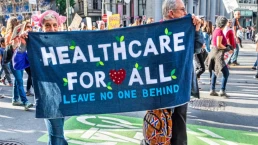
Free Primary Care for All
Whenever someone goes to the doctor, the bill they receive is paid either directly by them out of pocket, by their insurer, or through some combination of the two. The precise payment mix is determined by the cost-sharing rules contained in health insurance plans, which vary from policy to policy.
The Affordable Care Act established a list of ten essential health benefits (EHBs) that must be covered entirely by health insurers without any out-of-pocket cost-sharing for individuals. The Searchlight proposal would simply add primary care services as the eleventh EHB.
To evaluate the significance of this proposal, we need to know what percentage of current health spending goes to primary care services that are paid for out of pocket. The short Searchlight paper does not provide a definition of primary care services. So, for my analysis, I have adopted the definitions used in the Milbank Memorial Fund’s Primary Care Scorecard.
In the Milbank scorecard, author Yalda Jabbarpour provides both a narrow and a broad definition of primary care, which I replicate in the graph below.
Under the narrow definition — which includes general practice, family practice, internal medicine, pediatrics, and geriatrics — primary care makes up 4.5 percent of total health spending. Under the broader definition, the number goes up to 12 percent.
The vast majority of this spending (85 to 87 percent) is already paid for by insurers, not by individuals out of pocket.
When you add it all up, out-of-pocket primary care spending amounts to just 0.6 percent (narrow) to 1.8 percent (broad) of all health spending. This is a drop in the bucket, and if this proposal is implemented, households will end up paying higher premiums to make up for the increased insurer payouts, making it a wash overall with some winners and losers. This is not a bad thing to do, but it is fairly trivial in the grand scheme of things.
Recent Posts
Democrats Should Get Behind a National AI Data Center Moratorium
Take Action Now Democrats have a golden opportunity to capitalize on this issue, win big in November, and take real action on AI data centers to…

Another Way Out: Public Execution Is an Everyday Reality—Livestreamed or Not
Take Action Now For some, the Trump administration’s plan to livestream an execution was unacceptable because it wouldn’t happen behind closed doors……
Senate Democrats Demand Trump Administration Reveal Full Costs of Iran War
Take Action Now “Americans deserve to know how much of their money is being burned on Trump’s war,” Sen. Elizabeth Warren said.By Chris Walker,…

Stealing Palestine, Stealing Enlightenment
Take Action Now The authors trace the origins of Zionism, at least in large part, to Evangelical Christians who, much like back-to-Africa racists in…