
Trump has advanced his autocratic powers via a path well trod by a Republican administration before him.
By Rebecca Gordon, Tom Dispatch
In 2003, the Macedonian police arrested Khaled el-Masri, a German citizen vacationing in their country. They handed the unfortunate man over to the CIA, who shipped him off to one of their “black sites.” For those too young to remember (or who have quite understandably chosen to forget), “black sites” was the name given to clandestine CIA detention centers around the world, where that agency held incommunicado and tortured men captured in what was then known as the Global War on Terror. The black site in this case was the notorious Salt Pit in Afghanistan. There el-Masri was, among other things, beaten, anally raped, and threatened with a gun held to his head. After four months he was dumped on a rural road in Albania.
It seems that the CIA had finally realized that they had arrested the wrong man. They wanted some other Khalid el-Masri, thought to be an al-Qaeda associate, and not, as Amy Davidson wrote in the New Yorker, that “car salesman from Bavaria.”
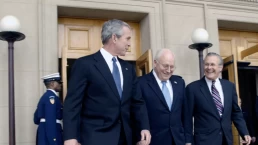
El-Masri was not the only person that representatives of the administration of President George W. Bush and Vice President Dick Cheney mistakenly sent off to another country to be tortured. In an infamous case of mistaken arrest, a Canadian citizen named Maher Arar was detained by the FBI at JFK Airport in New York while on his way home from a vacation in Tunisia. He was then held in solitary confinement for two weeks in the United States, while being denied contact with a lawyer before ultimately being shipped off to Syria. There, he would be tortured for almost a year until the Canadian government finally secured his release.
I was reminded of such instances of “extraordinary rendition” in the Bush-Cheney era when I read about the Trump administration’s March 2025 deportation of Kilmar Armando Abrego García to a grim prison in El Salvador. Because of threats against him and his family from Barrio 18, a vicious Salvadoran gang, Abrego García had fled that country as a young teenager. He entered the U.S. without papers in 2011 to join his older brother, already a U.S. citizen.
He was arrested in 2019, while seeking work as a day laborer outside a Home Depot store and handed over to U.S. Immigration and Customs Enforcement (ICE), which accused him of being a member of another Salvadoran gang, MS-13. This proved a false claim, as the immigration judge who heard his case agreed. While not granting Abrego García asylum, the judge assigned him a status — “withholding from removal” — which kept him safe in this country, because he faced the possibility of torture or other violence in his homeland. That status allowed him to work legally here. He married a U.S. citizen and they have three children who are also U.S. citizens.
Recent Posts

AI Doesn’t Need ‘Superintelligence’ or Evil Intent to Start a Nuclear War
Take Action Now Neither extraordinary machine intelligence nor malicious intent is required for catastrophe to result.By Paul Slovic and Herbert…

30 Months After Uproar Over Jonathan Glazer’s Oscar Speech, What Do His Pro-Israel Denouncers Say Now?
Take Action Now Given all that has happened, I recently contacted some signers of the open letter to ask whether they still fully believe in its…

Midterms Have Revived Universal Healthcare Debate. These States Are Ahead of Everyone.
Take Action Now States have often served as laboratories to test health policies later implemented nationally.By Markian Hawryluk, KFF Health……

Nobel Peace Prize Turns Toward Peace in 2026
Take Action Now To have finally acknowledged someone whose work in any way addressed the horrors of Zionism is an encouraging sign from the Nobel…