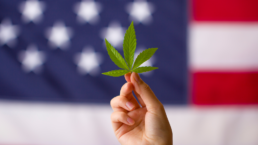
Further proof that an issue once considered a political hot button has gone mainstream.
By Paul Armentano, OtherWords
At a time when voters and politicians are historically divided, there is one issue that Americans largely agree upon: It’s time to legalize marijuana.
Months ago, Vice President Kamala Harris tweeted that “Nobody should have to go to jail for weed.” Despite her past opposition to marijuana legalization, she’s since become the first major presidential nominee to endorse it.
In a more recent social media post, Republican presidential candidate Donald Trump opined, “We do not need to ruin lives and waste taxpayers’ dollars arresting adults with personal amounts of it (marijuana) on them.”
That’s significant coming from Trump, who as president was on record supporting violent drug war crackdowns abroad and who appointed longtime anti-marijuana zealot Jeff Sessions to be his first Attorney General.
One look at recent polling data and it’s clear why the two candidates are finding common ground on cannabis. According to Gallup, 70 percent of U.S. adults believe that “the use of marijuana should be legal.”
That’s an increase of 19 percentage points since 2014, when Colorado and Washington became the first states to implement adult-use cannabis legalization. Twenty-four states have now done so — and no state has ever repealed marijuana legalization.
The public’s support is bipartisan. Nationwide, 87 percent of Democrats, 70 percent of independents, and 55 percent of Republicans support legalization. In important swing states like Michigan, Pennsylvania, and Wisconsin, legalizing marijuana similarly enjoys majority support.
It’s easy to see why. The initial push for cannabis criminalization, which began in earnest in the early 1900s, had little to do with any legitimate concerns about public health or safety. Rather, the move to ban marijuana and to criminally prosecute those who consume it was based primarily upon myths and xenophobia.
Today, nearly half of all drug-related arrests nationwide are for marijuana. This is a tremendous waste of time and resources that most Americans believe ought to be reprioritized toward targeting more serious crimes.
In addition, those arrested and prosecuted for violating marijuana laws face a litany of lifelong consequences — including a criminal record and the lost opportunities that come with it. Those arrested are disproportionately young people and socioeconomically disadvantaged.
Criminalization, despite its longevity, has failed to disrupt the illicit market or discourage marijuana use. By contrast, teens’ use of marijuana has plummeted since states have begun regulating marijuana sales. In addition, survey data finds that most cannabis consumers in legal states obtain their goods from licensed retailers, not from underground street dealers.
Legalization has also provided notable economic benefits for state governments. Since 2014, retail sales of adult-use cannabis products have generated more than $15 billion in tax revenue, which has funded school construction, affordable housing, and other services.
Given the success of legalization and the overt failures of marijuana prohibition, it’s hardly surprising to see the presidential candidates weighing in.
It’s notable, however, that it’s taken this long for them to publicly tout the issue. Trump previously mused that statewide legalization resulted in “big problems” in states like Colorado, while Harris urged California voters to reject a 2010 legalization ballot question.
But times have changed, and politicians are adapting accordingly. In an election where every vote counts, both Trump and Harris wisely see advocating for marijuana policy reform as an opportunity to connect with a wide range of potential voters.
It’s just further proof that an issue once considered to be a political hot button has since gone mainstream.
Paul Armentano is the Deputy Director for NORML, the National Organization for the Reform of Marijuana Laws (NORML). This op-ed was distributed by OtherWords.org.
Recent Posts

‘Act of Collective Punishment’: Netanyahu Condemned Over ‘Full Lockdown’ of Occupied West Bank
Take Action Now The reaction to a shooting incident in Hebron, said one Palestinian critic, “represents an alarming escalation in Israel’s policies…
‘Stop The War on Iran’: Brooklyn Peace Activists Urge Jeffries to Help End Conflict
Take Action Now Democrats have a golden opportunity to capitalize on this issue, win big in November, and take real action on AI data centers to…
A Blue Wave Won’t Wash Away Our Oligarchy Problem
Take Action Now The massive election spending by Elon Musk and other billionaires is a huge problem, even if many of the superwealthy’s favorites…
Democrats Should Get Behind a National AI Data Center Moratorium
Take Action Now Democrats have a golden opportunity to capitalize on this issue, win big in November, and take real action on AI data centers to…