
California is considering a referendum on whether to impose a one-time wealth tax on the state’s billionaires.
By Jim Naureckas, FAIR
The Washington Post, which exists mainly to serve the interests of its mega-billionaire owner Jeff Bezos, unsurprisingly thinks taxing the wealth of billionaires is a bad idea (FAIR.org, 12/11/19). Its recent editorial (1/1/26) warning California not to institute a tax on extreme wealth—headlined “California Will Miss Billionaires When They’re Gone”—illustrates that when you’re telling the boss exactly what he wants to hear, you don’t have to think very hard.
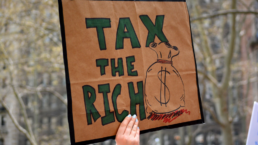
California is considering a referendum on whether to impose a one-time wealth tax on the state’s billionaires. The paper’s hot take: “Many progressives think of taxation the way teenage boys think about cologne: If some is good, more must be great.”
The paper offers PayPal’s Peter Thiel and Google‘s Larry Page, both of whom have threatened to leave California, as poster children for why you shouldn’t subject billionaires to a wealth tax—both highly dubious examples.
Thiel is well-known for his use of an absurd tax loophole (ProPublica, 6/24/21): He put 1.7 million shares of PayPal stock—which he valued at 0.1 cents apiece, so $1,700—into a Roth IRA, and by 2021 that had grown through reinvestment into a $5 billion nest egg. (In 2026, it’s likely the bulk of his $25 billion fortune.) A Roth IRA means that if he waits until 2027, when he turns 59, he won’t have to pay any taxes at all on that. This is precisely why people want a wealth tax, because the tax code makes it easy for oligarchs like Thiel to pay little or nothing in income tax.
Page is also known for tax shenanigans, parking much of his wealth in a “charity” that distributes almost none of its wealth to disclosed recipients (Vox, 12/18/19). When ProPublica (4/13/22) analyzed tax filings from the super-rich, Page had one of the lowest effective federal income tax rates among prominent billionaires.
‘Blew a hole in the budget’
To illustrate the fiscal danger California would be putting itself in with a wealth tax, the Post cited the example of New Jersey billionaire David Tepper, who “blew a hole in the state budget by moving to Florida.” That’s according to an article from Philadelphia public TV station WHYY (4/11/16), which said in 2016 that “while the amount Tepper paid in taxes last year is unknown to the public…a resident that rich [$11.4 billion] could pay tens or even hundreds of millions of dollars in income taxes if they paid New Jersey’s highest rate, 8.97%.”
The only way Tepper would have paid “hundreds of millions” in Jersey state income tax would be if he were declaring several billion in income a year. But Tepper reportedly made $750 million in 2016, which would be $67 million at the top tax rate—which he wouldn’t pay anyway, since he’s a hedge fund manager and benefits from a special tax loophole designed just for them.
In any case, Tepper moved back to New Jersey in 2020 (Politico, 9/24/20)—so it’s not clear what kind of object lesson he should serve for California. Was his 2016 move representative of a broader problem of the flight of the wealthy from New Jersey? It’s hard to see how, as the state has the highest concentration of millionaires in the country (Kiplinger, 5/27/20)—up from third-highest in 2014 (New Jersey Policy Perspective, 4/13/16).
Imaginary exodus
This is a perennial problem with the oligarchy’s don’t-touch-our-money arguments: They want to claim that they’ll run away from high taxes, but they like living in high-tax states. The LA Times‘ Michael Hiltzik (10/24/19) pointed this out years ago, responding to a similar editorial in the Wall Street Journal (“California’s Tax-the-Rich Boomerang,” 10/21/19).
The Journal leaned heavily on a study by two economists at the right-wing Hoover Institution, Joshua Rauh and Ryan Shyu, who the paper said found that “the likelihood of a wealthy resident moving out of California increased by about 40%” following an income tax hike on the ultra-wealthy. Hiltzik noted that the actual percentage of rich people moving out was quite small—increasing from 1.5% to 2.125%—and, more importantly, that Rauh and Shyu only looked at outgoing multi-millionaires, ignoring the fact that more affluent people were moving to the state than moving away.
More than six years later, the Post is still citing Rauh and Shyu, still talking about that same 2013 California tax hike and the imaginary exodus of plutocrats it caused. I don’t know why they should be any more convincing than they were a decade ago—but then, the editorialists only have to convince one reader that they’re doing their best to protect his fortune.
Recent Posts
Trump Slaps Harvard With Brand New Lawsuit as War on School Escalates
Take Action Now Donald Trump continues to go after the university after it refused to bend to his demands.By Finn Hartnett, The New Republic The…

Iran Hits Major Energy Production Units in the Persian Gulf in Retaliation to U.S.-Israel Strikes on Its South Pars Gas Field
Take Action Now Several Arab countries, along with Turkey, Pakistan, and Azerbaijan, issued a joint statement on Thursday asking Iran to halt its…
Illinois Democratic Nominee Says She Wouldn’t Support Schumer as Senate Leader
Take Action Now Stratton said voters are “fed up” with “business as usual and the status quo.”By Alexander Bolton, The Hill Illinois Lt. Gov.…

Most Impeachable Person in U.S. History
Take Action Now In 2026, Trump’s 2.0 impeachable offenses include his use of the paramilitary force ICE against the U.S. public; his blowing up…