
When an economy is more inclusive, the democratic process seems to be more inclusive as well.
By Zach Silk, Civic Skunk
The Fight for $15 turns a decade old this year, which means we have a decade of receipts for fear-mongering from minimum wage opponents, as well as a decade of results to put their sky-is-falling claims to rest once and for all. Sometimes it’s valuable to go back and check the record in order to remember how far we’ve come, and how much the argument has changed. Consider my home city of Seattle. More than eight years ago, the Seattle Times editorial board warned Seattle’s incoming elected leaders that their plans to adopt a $15 minimum wage “could undercut the economy’s resurgence” from the Great Recession. Less than two months later, they harrumphed that the Fight for $15 was “good political theater, but bad public policy.”
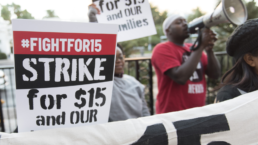
Once it became clear that city leaders were about to adopt $15, the Seattle Times editorial board tried to bargain the price down, warning that Seattle’s minimum wage could “rise to, or even slightly above $10.74 — San Francisco’s top-in-the-nation rate — without harming the local economy. But the higher it goes beyond historic precedent, the higher the risk,” they warned.
Of course, Seattle did adopt a $15 minimum wage — San Francisco would do the same not very long after — and despite the cries of critics like the editorial board, the sky did not fall. More workers made more money, restaurants continued to open, and consumer spending rose.
Last week, a Seattle Times columnist named Gene Balk — known locally as “The FYI Guy” because of his data-driven approach to journalism — published a new column with some very interesting findings. Despite the fact that Seattle is home to multiple billionaires and tens of thousands of wealthy tech workers, our city’s income inequality is much smaller than other cities of equivalent size and wealth, like Boston, Atlanta, and Washington DC.
How can Seattle keep inequality so much lower than our peers? “One factor keeping Seattle’s income gap in check is the city’s famously high minimum wage,” Balk explained. “Seattle passed its wage law in 2014, which gradually increased the minimum wage citywide. It’s now as high as $17.27 per hour for some workers — the highest in the nation. The average income for the lowest 20% of households in Seattle ($18,800) is the third-highest among the 50 largest U.S. cities.”
Recent Posts

“Propaganda Show”: IDF Raids Palestinian NGOs in the West Bank Ahead of Israeli Elections
Take Action Now “The raid onto the city center Ramallah is not a lonely activity. It happens every day that they raid different villages,…

ICE Planning $100 Million ‘Nightmare’ Domestic Spy Program
Take Action Now Under ERO ONE, Immigration and Customs Enforcement plans to hire 142 intelligence contractors with top secret clearances and deploy…
Postpone the AI Public Offerings Until Congress Acts
Take Action Now A company should not disclose a risk of catastrophe to humanity and then sell its shares to the public before any public authority…
Congress Has The Power to Fix the Trump-Saudi Nuclear Deal
Take Action Now Congress has at least 9 months and considerable leverage to make things right.By Alan J. Kuperman, Bulletin of the Atomic…