It’s not just about environmental rollbacks: Trump and Lee Zeldin have presided over a striking decline in the EPA enforcing existing laws.
By Nermeen Shaikh, Naghmeh Sohrabi, Amy Goodman, and Amir Ahmadi Arian, Democracy Now!
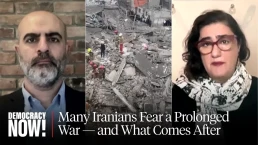
As the U.S. and Israeli war on Iran extends into a third week, President Trump is demanding other countries send warships to the Strait of Hormuz, which has been largely shut, as oil prices keep rising. This comes as the U.S. and Israel continue to launch major strikes on Iran, while Iran has retaliated by repeatedly striking Israel and U.S. allies in the Gulf, including the United Arab Emirates, Saudi Arabia, Kuwait and Bahrain. Despite the violence in Iran, “pro-war voices are definitely in the diaspora and very strong, but they also exist inside Iran,” says Naghmeh Sohrabi, professor of Middle East history at Brandeis University.
“I think most Iranians want this war to end as soon as possible, and at the same time, they fear nothing more than the day after the war, if this regime remains intact,” says Iranian American novelist Amir Ahmadi Arian.
Transcript
This is a rush transcript. Copy may not be in its final form.
NERMEEN SHAIKH: This is Democracy Now!, democracynow.org, The War and Peace Report. I’m Nermeen Shaikh in New York.
AMY GOODMAN: And I’m Amy Goodman in Los Angeles, where I attended the Oscars last night. I had a chance recently to speak with the winners of the documentary feature award, Mr Nobody Against Putin, and we’ll play that later. But first we go to Iran news with three people who were born in Iran. Nermeen?
NERMEEN SHAIKH: As the U.S. and Israeli war on Iran extends into a third week, President Trump is demanding other countries send warships to force open the Strait of Hormuz, which has been largely shut due to threats from Iran. President Trump spoke aboard Air Force One.
PRESIDENT DONALD TRUMP: I’m demanding that these countries come in and protect their own territory, because it is their territories. It’s the place from which they get their energy. And they should come, and they should help us protect it.
NERMEEN SHAIKH: Trump told the Financial Times it would be, quote, “very bad for the future of NATO” if allies don’t help secure the critical waterway. In recent weeks, global oil prices have jumped over 40% as Iran has blocked the flow of oil through the strait.
This comes as the U.S. and Israel continue to launch major strikes on Iran, while Iran has retaliated by repeatedly striking Israel and U.S. allies in the Gulf, including the United Arab Emirates, Saudi Arabia, Kuwait and Bahrain.
Meanwhile, the Lebanese Red Cross reports Israel’s attacks on Lebanon have now displaced more than 900,000 people. The death toll in Lebanon has topped 850.
We begin now with two guests. Naghmeh Sohrabi is a professor of Middle East history at Brandeis University. Earlier this year, she began translating articles from Persian to English by writers inside the country. Her recent piece for Equator is headlined “Iran’s Fearless Intellectuals.” She’s written extensively on Iranian history and politics and was previously the president of the Association for Iranian Studies.
We’re also joined by professor Amir Ahmadi Arian, an Iranian American novelist and journalist. He left Iran 15 years ago. He’s a creative writing professor at Binghamton University. His most recent piece for The New York Review of Books is headlined “Of Fire and Rain.”
Welcome, both of you, to Democracy Now! Naghmeh, let’s begin with you. If you could talk about the articles that you’ve been translating since earlier this year and what people in Iran are telling you about the situation on the ground?
NAGHMEH SOHRABI: Thank you for having me.
I started translating these articles after the January brutality and atrocity of the state towards the protesters. So there’s been a whole series of events and articles about that. But specifically about what is going now, there’s been a trickle coming through. But what has really been interesting has been two things. One is the way in which a lot of these writers are articulating how stuck many people are in between a repressive regime and a war. In other words, rather than trying to say they’re either against the Islamic Republic, and therefore pro-war, or against the war, therefore siding on the Islamic Republic, a lot of people have been trying to understand and express what it means to be neither of these two things in a society and in a world which is very, very polarized.
In addition to that, a lot of people have been writing, those who can get it out — and we can talk a little bit later about the communications difficulties — have been writing about what remains after the wars have — after the bombs have stopped — right? — the shockwaves that go through neighborhoods, the everyday life, people going to the store, people having to deal with their children, people having to deal with work. And it’s very important to keep these in mind, because we do have a tendency in times of war to focus on the dead and on the destruction, and we tend to forget that there are people who, after the bombs fall, have to go about some kind of life.
And I’ll just give you a small example of details that come out when we listen to voices on the ground, which is about there being now a glass shortage in Tehran. So, even though these are technically surgical strikes and — they’re hitting buildings, and then the shockwaves are going through the neighborhood and pulling down a wall or shattering constantly glasses. And so, people have had to go and try to, if they — there’s not enough glass to repair these glasses, so people are basically sitting in these half-destroyed homes trying to protect their properties as wind comes and goes through the building. So, the situation becomes a lot more complicated when we listen to them.
AMY GOODMAN: Professor Sohrabi, you write in your piece about how people are feeling completely crushed by two forces, by the pro-war movement in the diaspora of Iranians outside of Iran and the crushing assault of the regime. If you can explain?
NAGHMEH SOHRABI: Yes, I will explain, but I’ll expand what you’re saying to say it’s really important to remember that the pro-war voices are definitely in the diaspora and very strong, but they also exist inside Iran, and they are very strong, though we don’t know majority, not majority. It actually doesn’t matter. And the reason that’s important is because what a lot of people inside Iran have to contend with is the environment in which they’re living in. And what that has done for people who feel they are neither for this war, because of the immense level of destruction that’s taking place in it, nor for the Islamic Republic, because of all the years of repression and brutality that they have had to experience, there’s a sense of isolation that is developing among that segment of the population, a sense of withdrawal. Somebody said to me very recently, “I’ve just stopped talking to anybody. I can’t talk to anyone, because it’s either this one or that one.” And another intellectual that I was speaking to talked about the fact that there’s a sense of despair on top of everything else, because they feel like they failed in trying to get people in their world, in their environment, to understand that despite everything that’s going on in Iran, the war was not going to help them transition out of this government.
The last thing I will say about this is that I’m very interested in ideas that are coming out of Iran. I think we all have a tendency to treat the Middle East, in general, but Iran also, as a cause and not as a generator of ideas. We talk about Iranians or the region when they come out to protest. We talk about them when they’re casualties of war. But they’re also trying to create ideas out of this — what you just talked about, Amy — out of this really intense pressure from multiple sides. And it’s important to keep these ideas at the forefront of our own analysis. In other words, don’t treat the Middle East or Iran just as a cause, but as people who are thinking through and incorporating these thoughts into our own analyses of what’s going on.
NERMEEN SHAIKH: So, I’d like to bring professor Amir Ahmadi Arian into the conversation, too. In your piece in The New York Review of Books headlined “Of Fire and Rain,” you write that despite being a vocal critic of the Iranian regime, that once the U.S. and Israel began bombing Iran, you felt towards the country as you do towards your children. If you could elaborate on that?
AMIR AHMADI ARIAN: Yeah, actually it was in reference to the previous war, to the 12-Day War. But yeah, that was something that was like a — almost like a switch in my head, that, you know, when we talk about a country, you know, the metaphor often used is a country as your parent. We use terms like “fatherland,” “motherland.” In Persian, we say madar vatan or sarzamin e pedari. So there is like a parental relationship with one’s homeland. And there’s this expectation that our country protect us, nurture us, prepare us for the future and so on. This is — you know, I think this is an expectation most people on the planet take for granted. You see it in the U.S. all the time. If you talk to Americans, you know, a lot of times you hear about how their country has let them down.
So, I had that relationship with Iran, too. And even though I, you know, grew up during the Iran-Iraq War on the frontline, and my mom was a nurse in frontline hospitals, so in my entire childhood, all the eight years, I lived very close to the frontline of that war, because I was so small, I forgot what the war does, you know, to your relationship to your homeland. And then, last year, when those attacks started, all of a sudden I found this switch. You know, I found this shift in my relationship, in my perspective, that this didn’t look like a parent anymore, you know, someone strong you can rely on, but a child that needs some sort of a protection. And, you know, it felt like I was watching a volatile, fragile being, you know, being sort of battered by a bunch of strangers.
And that’s a feeling that has been intensified over the year. You know, it started with the 12-year war — 12-Day War, then really intensified during the January massacre, you know, in which the Islamic Republic basically declared war on Iranian people and killed tens of thousands of them on the streets of Iran. And now we are in a new phase of that, with another round of bombing and an assault by two armed-to-teeth governments at the same time, while the threat of the Islamic Republic hasn’t abated at all. So, this is, you know, the psychological pressure of that, especially for those of us in diaspora living in the safety, and in our particular case, living in the United States, where, you know, our tax money, a substantial portion of it is going to the U.S. Army — all of these contradictory feelings and, you know, perceptions of reality really takes a toll.
AMY GOODMAN: Professor Arian, if you can talk about the impact of the U.S.-Israeli war on Iran on the protest movements within Iran, and then also talk about your critique of the Western media coverage, what we’re learning here in the United States?
AMIR AHMADI ARIAN: I think my critique of the Western media coverage is very much, you know, aligned with what Professor Sohrabi just said, that you see it is pretty divided along, you know, like the left and right, at least the American left and right lines. If you look at, you know, the lefties, they are very much focused on an antiwar agenda. They want the bombing to stop and so on. And if you look at the right, they look at — they sort of present this war as a sort of a liberation operation and point out, you know, the regime brutalities over time, and showing that, you know, the damage it has caused have been much more severe than even this intense bombing so far. I mean, this simplification, I think, is understandable, because this is a situation that is very complicated and difficult to grasp.
I think the fact of the matter is that if you live in Iran right now, you’ve got to square two sort of contradictory ideas about the future. I think most Iranians want this war to end as soon as possible, and at the same time, they fear nothing more than the day after the war, if this regime remains intact. So, you know, there’s nothing — I think anyone who has been in a war zone at any point in their lives, I think they know, you know, without a shadow of doubt, that nothing good comes out of any war. You know, there’s no clean war. There’s no clean bombing. Even this, like, precise — so-called precise — attacks on military or government targets in Iran, they cause very severe civilian casualty, you know, the damage to cultural heritage, the environmental effects of that. We just saw what happened in Tehran after they bombed the oil refineries and oil depots. So, I think it’s pretty clear to anyone who knows anything about war that the path to a better society, a more prosperous, a more democratic society, never goes through a war.
And on the other side, the fact is that, you know, the regime in Iran — and I call it “the regime” because it’s been reduced to its, you know, security forces, oppression forces — they have shed all pretenses of governance. So, they are also looking at the Iranian people as their enemy, and they’ve been very clear about that. If you look at the state media, they’re frequently threatening them that if they go out into the street and show any sign of discontent with the state, stage any sort of protest or celebrate the death of Ali Khamenei, which a lot of people did, they’re going to come after them and kill them. I mean, they did that the day after Khamenei died. They shot a bunch of people, and we had casualties. They even shot at the windows of the houses where people were celebrating.
So, you’ve got to be able to square this kind of contradictory situation. You’ve got to find a framework in which both the U.S.-Israeli bombing of Iran and the war that the regime in Iran is waging against its own population are included, are incorporated. It’s very difficult, and, honestly, I am not sure if I can do it. But this is the only honest and, you know, sincere take on Iran, which is largely absent from the coverage in the Western media.
As for your first question about the impact of that on the protest movement in Iran, you know, I know from personal experience, even though I was very small, but, you know, that war lasted long enough for me to sort of have a pretty good sense of what it does to a civilian population. When the war ends, it doesn’t end. I mean, it lives with you for the rest of your life. I still have nightmares about the events that I experienced when I was 5 years old. And, you know, a war of that magnitude on a country, that has been so weakened and so brutalized by the state, by the sanctions, and so on and so forth — it’s a long story — the exhaustion that it will cause, the sense of draining and despair that it will cause — it has caused already, after two weeks — is, you know, so profound and so paralyzing. Then, the expectation that people come out of this war and organize a political movement to start even think about doing anything that will lead to a meaningful change in the political status quo, it’s a fantasy.
You know, right now, as soon as the bombs start to fall, people’s survival instinct kick in. They look for shelter. They look for water and food. They want to protect their family, especially their kids. And they’re going to stay in the survival mode as long as the war goes on. And after the bombing stops, which, you know, none of us knows when that will happen, it takes months to kind of process this situation, to kind of live with this trauma or incorporate that trauma into their life and even start thinking about doing sort of anything else, to organizing your going out or, you know, participating in any kind of political process. So, the —
NERMEEN SHAIKH: Professor Arian —
AMIR AHMADI ARIAN: Yeah, sorry.
NERMEEN SHAIKH: I’m afraid we’re going to have to leave it there. Thank you so much for joining us, professor Amir Ahmadi Arian, Iranian American novelist and journalist. He left Iran 15 years ago. He’s a creative writing professor at Binghamton University. We’ll link to your recent piece for The New York Review of Books, “Of Fire and Rain.” And Professor Naghmeh Sohrabi, Middle East professor of history at Brandeis University, we’ll link to your piece in the Equator, “Iran’s Fearless Intellectuals.”
Coming up, we go to Jerusalem to speak with the Iranian Israeli journalist Orly Noy. Stay with us.
[break]
NERMEEN SHAIKH: “Al-Ras ’Aly,” “Heads Held High,” performed at a Gaza benefit concert here in New York by the New York City Palestinian Youth Choir.
Recent Posts
Tax Day 2026: The Average Taxpayer Paid $4,049 for War and Weapons
Take Action Now Wars don’t just cost taxpayers at the pump. Here’s what the average taxpayer spent for different priorities in 2025By…
Bombshell Report Reveals Trump Was Begging for Iran to Join Ceasefire
Take Action Now This contradicts everything the president has said about the war.By Malcolm Ferguson, The New Republic Recent reporting from the…

Massive Israeli Assault on Lebanon Threatens U.S.-Iran Ceasefire
Take Action Now Over 250 people were killed in what the Israeli military said was the “largest coordinated strike” on Lebanon since March 2.By…
Is the War In Iran About to Become Apocalyptic? (w/ Trita Parsi)
Take Action Now As Trump escalates threats, oil chokepoints tighten, and talk of “total surrender” creeps toward the unthinkable, Trita Parsi warns…