
Fabricio said that he and his family went out of their building and saw many people also going outside, running around, and kids screaming that they didn’t want to die.
By David Swanson, World BEYOND War
I’m on the third day of a peace delegation from the U.S. and other countries to Venezuela. I posted about the second day here and first day here.
Now day 3:
Below is a photo of me with two boys in a neighborhood of Caracas that was attacked by the U.S. military on January 3rd. At left is Antoniel, at right Fabricio. They have stories to tell.
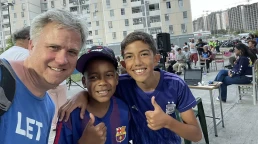
Life is very communal in the neighborhoods of Caracas, and word gets around. When we were being told about the January 3rd attacks, very quickly a boy showed up who could tell us what he saw.
Fabricio, who turns 12 next month, said his apartment building shook, and looking out the window he saw a missile headed toward a nearby telecommunications station. Then he saw a helicopter fly past, he said.
Fabricio said that he and his family went out of their building and saw many people also going outside, running around, and kids screaming that they didn’t want to die.
Others told us that windows had shattered, and that some children were too scared to move and had to be carried.
Fabricio’s family got into a car and drove as fast as possible to another town. As soon as they’d gotten into the car, Fabricio said, his grandfather called him on the phone. And his grandfather said that he was very glad that his grandmother was no longer living to see this day. Fabricio said that he later thought that perhaps his grandmother, if she’d been alive, would have had a heart attack. We were told that there were, in fact, two heart-attack deaths in this neighborhood in the week after the military attack.
I apologized to Fabricio, and he said No, no, that he understood, that we were in his heart, and that our government was something else entirely.
Then he asked if he could sing us a song:
This neighborhood — also in the images below — is near some military facilities, and is in fact one of a number of projects initiated by Hugo Chavez to give free new apartments to civilians on military land. Also nearby are a telecommunications station that was attacked and a safehouse that President Maduro was apparently trying to reach when he was captured.
People here saw missiles, helicopters, and drones. A tank that was always parked nearby was utterly destroyed.
One woman, according to a story several people told us, ran out with her nine-year-old boy, who saw a line of helicopters coming and made the mistake of assuming they were friendly and waved at them — upon which one of the helicopters began shooting at these two people, who reportedly tried to hide, lying down behind the tiny wall in the picture below.
A number of people told us that the worst impact was psychological, and that they suffer when they hear loud noises. A U.S. military veteran — now working for peace — in our delegation collapses to the ground when he hears loud noises, so it’s understandable that people have had this reaction.
We saw a number of blue and yellow macaws flying to the upper floors of some apartment buildings to be fed. We were told that for two weeks after January 3rd the macaws disappeared. Someone else told me that in another neighborhood the macaws did not go away, but for weeks after the attack completely changed their song to something discordant.
On top of a hill in one of the photos below is the safe house Maduro failed to reach.
Another photo shows dancing aimed at healing the Earth.
Later, Antoniel told us his story. He was some distance away at a cousin’s birthday party, which ended at 2 a.m.
He heared bombing and saw the sky — out the window — turning red.
He got a call from his aunt in his neighborhood telling him and others not to come home.
In this same neighborhood, we were read this poem by Nicolás Guillén:
No sé por qué piensas tú,
soldado, que te odio yo,
si somos la misma cosa
yo,
tú.
Tú eres pobre, lo soy yo;
soy de abajo, lo eres tú;
¿de dónde has sacado tú,
soldado, que te odio yo?
Me duele que a veces tú
te olvides de quién soy yo;
caramba, si yo soy tú,
lo mismo que tú eres yo.
Pero no por eso yo
he de malquererte, tú;
si somos la misma cosa,
yo,
tú,
no sé por qué piensas tú,
soldado, que te odio yo.
Ya nos veremos yo y tú,
juntos en la misma calle,
hombro con hombro, tú y yo,
sin odios ni yo ni tú,
pero sabiendo tú y yo,
a dónde vamos yo y tú…
¡no sé por qué piensas tú,
soldado, que te odio yo!
(I don’t know why you think, Soldier, I hate you, If we are the same thing I, you. You are poor, I am; I am from below, you are; Where did you get Soldier, that I hate you? It hurts me that sometimes you forget who I am; Wow, if I’m you the same as you are me. But that’s not why I I must love you, you; If we’re the same thing, I, You, I don’t know why you think soldier, I hate you. I’ll see you and you, Together on the same street, Shoulder to shoulder, you and me without hatred neither me nor you, But knowing you and I where are I and you going… I don’t know why you think, soldier, I hate you!)
A Peace Flotilla
Earlier in the day on Sunday, we joined a group of fishermen and fisherwomen on the coast and sailed a peace flotilla in the Caribbean. Missiles also struck near this spot on January 3rd. But they never stopped fishing. Buildings have been rebuilt in a matter of weeks. The beaches are full of sunbathers and boogie-boarders.
The fishing crews sing songs about peace. Some photos and videos are below.
Recent Posts
As Trump Talks of Taking Cuba, Havana Promises “Impregnable Resistance”
Take Action Now According to recent reporting, officials inside the administration are treating Díaz-Canel’s removal as a condition for any future…
Trump’s War on Iran Could Cost Trillions
Take Action Now “My kids’ kids, and probably their kids, are going to be paying for this,” said one official briefed on the U.S war on Iran.By…
DNC Approach To Israel Is Political Malpractice And Moral Failure
Take Action Now No matter how much the DNC leadership tries to shunt it aside, the burning issue of U.S. policy toward Israel will not go away.By…
Ending the Trump-Netanyahu War in the Middle East
Take Action Now If not stopped soon, this war could easily turn into a global conflagration, effectively into World War III.By Jeffrey D. Sachs…