
By Brett Wilkins, Common Dreams
As President Joe Biden aims to assure the world that the United States will fulfill its promise to slash its greenhouse gas emissions in half from 2005 levels by the end of the decade, a new report published Friday reveals that the members of the U.S. Senate who would have to pass climate legislation are heavily invested in the fossil fuel industry.
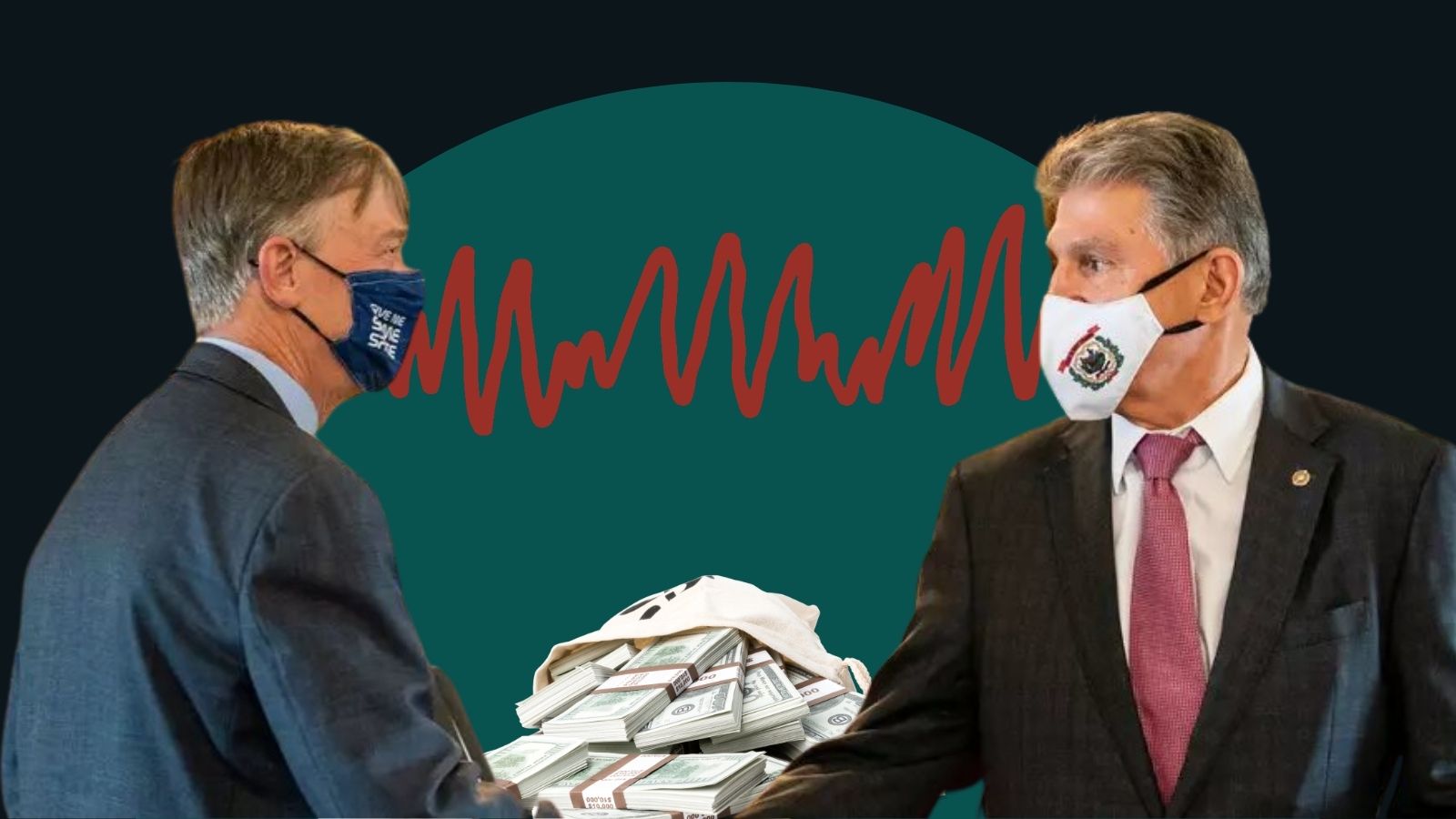
Sludge reports the households of at least 28 U.S. senators—in both the Democratic and Republican caucuses—hold a combined minimum of $3.7 million and as much as $12.6 million in fossil fuel investments.
Now seems like a good time to let you know that 28 Senators and their families own up to $12,600,000 in fossil fuel investments.
— Public Citizen (@Public_Citizen) November 5, 2021
According to the report:
Of the 28 senators, at least 20 hold publicly traded stocks in companies like oil supermajor Chevron, pipeline giant Enterprise Products, or electric utility NextEra that belong to trade associations that are lobbying Congress against taking up strong legislation to curb polluting emissions.
Five senators are invested in energy funds built around oil and gas assets, and three own nonpublic stock in private fossil fuel companies. The investments, held by the senators, their spouse, jointly, or a dependent, are disclosed to the Senate Office of Public Records in very broad ranges and often buried in hundreds of pages of scanned paper forms, making a more precise count of their total value impossible.
At least half a dozen of the senators sit on environment- or climate-related committees. The household of Senate Energy and Natural Resources Committee Chair Joe Manchin (D-W.Va.)—who has worked incessantly to destroy or dilute climate action in the Build Back Better Act and beyond—has received over $1 million in income from Enersystems, a coal brokerage firm the senator founded in the 1980s.
According to Sludge, Manchin “has stripped the Democrats’ budget reconciliation bill of major climate programs that would have transitioned coal-fired plants like the one where the company, now run by his son, holds a prime fuel services contract,” while the committee he chairs “also added more than $11.3 billion in funding to the bipartisan infrastructure bill that could benefit his family company’s niche waste coal industry.”
Other Democratic senators whose households are heavily invested in fossil fuels include:
- John Hickenlooper (Col.) holds up to $1 million in investments in Chevron and other polluters;
- Tom Carper (Del.) owns as much as $274,000 in Chevron and Duke Energy shares;
- Gary Peters (Mich.) has up to $355,000 in NextEra, DTE Energy, and Pacific Gas & Electric stock in his portfolio; and
- The wife of Angus King—a Maine independent who caucuses with Democrats—owns up to $50,000 worth of NextEra shares.
Earlier this year, Common Dreams reported that six Democratic senators—Manchin, Chris Coons (Del.), Maggie Hassan (N.H.), Mark Kelly (Ariz.), Kyrsten Sinema (Ariz.), and Jon Tester (Mont.)—have received hundreds of thousands of dollars in combined campaign contributions from fossil fuel corporations, some of which have touted their purported support for climate action, over the past decade.
Recent Posts

Angie Nixon Says the Fight for Black Voting Power Demands Elected Officials ‘Get Louder’
Take Action Now As Black Floridians confront shrinking representation and political disillusionment, Nixon says the moment demands persistence.By…

Progressives Saw Wins in DNC, But Battle for the Future of the Party Continues
Take Action Now Resolutions calling to abolish ICE and pushing to block arms sales are laying a progressive groundwork for 2028.By Sam Rosenthal,…

Congress Must Investigate War Profiteers Once Again
Take Action Now Ninety years after the original Nye Committee exposed the arms industry’s corruption, the Pentagon and its contractors are bigger,…

Christa Pike Hospitalized in Critical Condition After Botched Execution
Take Action Now “I’ve never seen anything like what we saw Wednesday night,” said one reporter who witnessed the execution attempt.By Amy Goodman,…