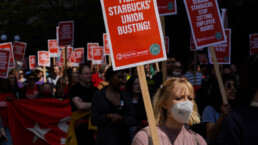
The National Labor Relations Act still functions, just barely, for Starbucks workers. Employees at fast-food franchises face even worse odds under federal labor law.
by Brian Callaci, Dissent
On February 27, after over two years of gutsy and strategic organizing, Starbucks Workers United forced Starbucks to surrender to its workers’ wishes and recognize their legal right to a union under the National Labor Relations Act (NLRA). The baristas’ union and the company have agreed to a national framework for contract bargaining and for recognizing the wishes of workers at non-union stores to join the union. Earlier that month, after twelve years of similarly courageous fighting, workers in another union campaign against chain restaurants, Fight for $15, celebrated a different kind of victory: the creation of a tripartite Fast Food Council—bringing together workers, industry, and government—that will regulate wages in the fast food industry in California. The sector-wide minimum wage of $20 per hour went into effect on April 1.
While Starbucks workers still have a long way to go to win a good contract and organize thousands of remaining non-union stores, they have already achieved what in recent decades has been nearly impossible: unionizing a large national corporation from scratch under federal labor law. It seems that for employees of corporations like Starbucks, the NLRA still functions, barely, if the conditions are just right.
By contrast, the Fast Food Council was created entirely outside of federal labor law. In the years leading up to the council’s creation, the SEIU-led Fight for $15 won major gains for fast food workers. It transformed public policy around the minimum wage and secured massive legislative wage gains for millions of workers, and it is now setting up an entire wage-regulation apparatus, including worker representation, in the state of California. Yet all this was achieved without winning an NLRB-certified union election or bargaining a contract at a single fast-food restaurant.
Recent Posts
AI Doesn’t Need ‘Superintelligence’ or Evil Intent to Start a Nuclear War
Take Action Now Neither extraordinary machine intelligence nor malicious intent is required for catastrophe to result.By Paul Slovic and Herbert…
30 Months After Uproar Over Jonathan Glazer’s Oscar Speech, What Do His Pro-Israel Denouncers Say Now?
Take Action Now Given all that has happened, I recently contacted some signers of the open letter to ask whether they still fully believe in its…
Midterms Have Revived Universal Healthcare Debate. These States Are Ahead of Everyone.
Take Action Now States have often served as laboratories to test health policies later implemented nationally.By Markian Hawryluk, KFF Health……
Nobel Peace Prize Turns Toward Peace in 2026
Take Action Now To have finally acknowledged someone whose work in any way addressed the horrors of Zionism is an encouraging sign from the Nobel…