But with corporations insistent on squeezing more profits no matter the cost, strikes are inevitable — and necessary.
By Sonali Kolhatkar, Other Words
The United Auto Workers (UAW), a union of nearly 150,000 workers at America’s “Big Three” automakers, are on strike.
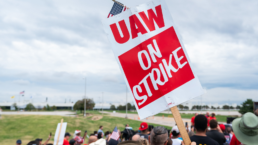
On the face of it, UAW’s demands sound audacious. They’re calling for a 46 percent pay raise and a four-day workweek, among other things. But in the broader context of a decades-long decline in labor rights and wages, they’re perfectly reasonable.
What’s unreasonable is massively profitable corporations’ insistence on squeezing every last drop of productivity from their workers with paltry wages, long hours, and little-to-no job security — and then feigning outrage at union demands.
The Big Three made more than $20 billion in profits in the first half of 2023 alone. Their CEOs are compensated to the tune of tens of millions of dollars a year. Meanwhile, even the top-paid auto workers earn less than six figures a year. Temporary workers start at only $17 an hour.
After years of making concessions, auto workers believe they — and not just their bosses — should share in the industry’s record profits. “Record profits mean record contracts,” as UAW president Shawn Fain put it.
Linking worker pay to CEO compensation is a savvy move. As unions remain popular, the idea of sharing the wealth appeals to a basic sense of fairness among the public.
It also makes financial sense for the automakers themselves. When GM workers went on strike in 2019 for 40 days, the cost to the company was far greater than anticipated — nearly $4 billion.
NBC estimates that meeting the union’s salary demands today would cost the companies comparable amounts — but spread out over much longer periods. “A 40 percent wage bump for UAW members would cost GM $4 billion to $5 billion and Ford $5 billion to $6 billion over four years,” they report.
But rather than offer salaries that enable workers to budget their lives, buy homes, and project expenses, the Big Three want to pay workers individual bonuses during years when profits are high. Their ostensible reason is to remain flexible as the industry is pressured into evolving away from fossil-fuel based vehicles to all-electric vehicles in the face of a warming climate.
But President Joe Biden’s administration just announced a massive funding plan to boost EV production and tied it to labor rights. “Building a clean energy economy can and should provide a win-win opportunity for auto companies and unionized workers who have anchored the American economy for decades,” Biden said.
In short, automakers can unlock federal funding, avoid disruptions to their inventories, and ensure that their financial losses are spread out over several years rather than just a few months — all by simply meeting UAW’s salary demands.
What more incentives do the big companies need?
There’s another beautiful win-win opportunity for workers and automakers in the EV transition. It takes significantly less labor to make an EV compared to a gas-run car. According to Ford, it’s 40 percent more labor efficient to make EVs.
According to UAW, auto workers “are working 60, 70, even 80 hours a week just to make ends meet.” But if they’re making EVs, they could work fewer hours at a higher rate without impacting production or their yearly salaries. Studies show that the companies would likely remain profitable and retain employees better if they switched to a four-day workweek with no loss of pay.
UAW’s demands, in short, are hardly unreasonable. But with corporations insistent on squeezing more profits no matter the cost, merely pointing out the mutually beneficial rewards of meeting union demands isn’t enough to sway shareholders and their allies.
So the striking workers are fighting for their demands. It remains to be seen how much autoworkers can flex their power. The Big Three can certainly test their patience and find out.
Sonali Kolhatkar is the host of “Rising Up With Sonali,” a television and radio show on Free Speech TV and Pacifica stations. This commentary was produced by the Economy for All project at the Independent Media Institute and adapted for syndication by OtherWords.org.
Recent Posts

‘Act of Collective Punishment’: Netanyahu Condemned Over ‘Full Lockdown’ of Occupied West Bank
Take Action Now The reaction to a shooting incident in Hebron, said one Palestinian critic, “represents an alarming escalation in Israel’s policies…

‘Stop The War on Iran’: Brooklyn Peace Activists Urge Jeffries to Help End Conflict
Take Action Now Democrats have a golden opportunity to capitalize on this issue, win big in November, and take real action on AI data centers to…
A Blue Wave Won’t Wash Away Our Oligarchy Problem
Take Action Now The massive election spending by Elon Musk and other billionaires is a huge problem, even if many of the superwealthy’s favorites…

Democrats Should Get Behind a National AI Data Center Moratorium
Take Action Now Democrats have a golden opportunity to capitalize on this issue, win big in November, and take real action on AI data centers to…