
The protests in Atlanta build on a history of organizers challenging prison construction as a force for environmental destruction.
by Amna A. Akbar, Dissent
On Saturday, March 4, I arrived at Intrenchment Creek Park in DeKalb County, Georgia, for the first day of a week of action against a $90 million construction project undertaken by the Atlanta Police Foundation—a private entity, backed by local CEOs and political leaders, that advances police interests. The foundation wants to raze eighty-five acres of public forest to build the largest police training facility in the United States, complete with a firing range, a burn building, and a “kill house” designed to mimic urban combat scenarios. It also argues that the facility will boost morale among officers. The size and scale of the project, and the destruction and deforestation it will require, have led a growing number of activists, organizers, and community members to object to what they call “Cop City.” The campaign against Cop City is simultaneously a campaign to defend the Weelaunee Forest, the name used for the area by the Muscogee Creek people forcibly displaced by settlers from the land in the early 1800s before it became the site of the notorious Atlanta Prison Farm. These elements of the campaign—the histories on which it draws, what it’s fighting against and for, who it is bringing together, and how—have given it tremendous staying power despite extraordinary odds.
Locals often describe Atlanta as “a city in a forest,” with trees and a tree canopy covering almost half of the land. The ecosystem depends on this foliage, and activists say that the deforestation required to build the facility will harm air quality, hasten climate change, and contribute to flooding in predominantly poor and working-class Black and brown communities. The proposed development will further distance residents from accessible green space while bringing toxic waste closer. But the project will do more than fracture the largest green space in Atlanta. The activists fighting against Cop City argue that police violence itself constitutes an environmental hazard, and that toxic chemicals associated with explosives that could be used on the site will destroy the air, water, and land on which myriad forms of life depend.
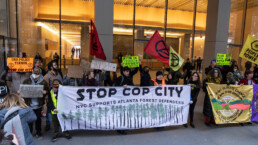
The week of action I attended was organized in remembrance of Tortuguita, or Manuel Esteban Paez Terán, the twenty-six-year-old nonbinary forest defender killed by Georgia State Patrol on January 18. Activists I met affectionately abbreviated their name to “Tort.” While police originally claimed self-defense, body-camera footage and two different autopsies show police shot Terán thirteen or fourteen times and suggest they were sitting cross-legged with both hands up when the police fired. Terán’s mother has since come to Atlanta from Panama to file suit against the city for records of her child’s murder, and to demand justice with a growing coalition at her side.
Recent Posts

‘Hit the Brakes’: Anthropic CEO’s Push to ‘Pace’ AI Development Called Latest Sign Congress Must Act
Take Action Now “When the future of humanity is at stake we need a PAUSE on advanced AI development and a ban on artificial superintelligence,” said…

Accountability for the Gaza Genocide Can’t Focus on Netanyahu Alone
Take Action Now Getting rid of one bad leader won’t bring justice.By Jeet Heer, The Nation On Thursday, former US Secretary of State Hillary…

25 Years of War Was the Wrong Response to 9/11
Take Action Now Both Democrats and Republicans are responsible for these counter-productive choices, and the appalling human costs of these wars on…

How Status Quo Democrats Could Create Another Trump
Take Action Now A new study suggests Democrats’ broken promises won’t just cost them elections — they could fuel an even more dangerous MAGA…