From riot gear to PR to Dairy Queen, records detail every expense Enbridge reimbursed after the Line 3 protests.
by Alleen Brown & John McCracken, Grist
The morning of June 7, 2021, Sheriff’s Deputy Chuck Nelson of Beltrami County, Minnesota, bought water and refreshments, packed his gear, and prepared for what would be, in his own words, “a long day.” For over six months, Indigenous-led opponents of the Line 3 project had been participating in acts of civil disobedience to disrupt construction of the tar sands oil pipeline, arguing that it would pollute water, exacerbate the climate crisis, and violate treaties with the Anishinaabe people. Officers like Nelson were stuck in the middle of a conflict, sworn to protect the rights of both the pipeline company Enbridge and its opponents.
Nelson drove 30 minutes to Hubbard County, where he and officers from 14 different police and sheriff’s departments confronted around 500 protesters, known as water protectors, occupying a pipeline pump station. The deputy spent his day detaching people who had locked themselves to equipment as fire departments and ambulances stood by. A U.S. Customs and Border Protection helicopter swooped low, kicking dust over the demonstrators, and officers deployed a sound cannon known as a Long Range Acoustic Device in attempts to disperse the crowd.
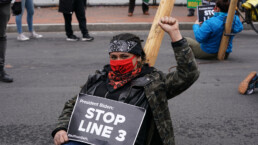
By the end of the day, 186 people had been detained in the largest mass-arrest of the opposition movement. Some officers stuck around to process arrests, while others stopped for snacks at a gas station or ordered Chinese takeout before crashing at a nearby motel.
These latter details might be considered irrelevant, except for the fact that the police and emergency workers’ takeout, motel rooms, riot gear, gas, wages, and trainings were paid for by one side of the dispute — the fossil fuel company building the pipeline, which spent more than $79,000 on policing that day alone.
When the Minnesota Public Utilities Commission gave Enbridge permission in 2020 to replace its corroded Line 3 pipeline and double its capacity, it included an unusual condition in the permit: Enbridge would pay the police as they responded to the acts of civil disobedience that the project would surely spark. The pipeline company’s money would be funneled to law enforcement and other government agencies via a Public Safety Escrow Account managed by the state.
By the time construction finished in fall 2021, prosecutors had filed 967 criminal cases related to pipeline protests, and police had submitted hundreds of receipts and invoices to the Enbridge-funded escrow account, seeking reimbursement. Through a public records request, Grist and the Center for Media and Democracy have obtained and reviewed every one of those invoices, providing the most complete picture yet of the ways the pipeline company paid for the arrests of its opponents — and much more.
From pizza and “Pipeline Punch” energy drinks, to porta potties, riot suits, zip ties, and salaries, Enbridge poured a total of $8.6 million into 97 public agencies, from the northern Minnesota communities that the pipeline intersected to southern counties from which deputies traveled hours to help quell demonstrations.
By far the biggest set of expenses reimbursed from the Enbridge escrow account was over $5 million for wages, meals, lodging, mileage, and other contingencies as police and emergency workers responded to protests during construction. Over $1.3 million each went toward equipment and planning, including dozens of training sessions. Enbridge also reimbursed nearly a quarter million dollars for the cost of responding to pipeline-related human trafficking and sexual violence.
Reporters for Grist and the Center for Media and Democracy reviewed more than 350 records requested from the Minnesota Public Utilities Commission, pulling out totals described in invoices and receipts and dividing them into categories such as equipment, wages, and training. Each agency had its own method for tracking expenses, with varying levels of specificity. In cases where reporters were unable to cleanly disentangle different types of expenses, those expenses were categorized as “other/multiple.” Generally, totals should be considered conservative estimates for each category.
The $79,000 that Enbridge paid for the single day of arrests on June 7, which doesn’t include much of the Enbridge-funded equipment and training many officers relied on, displays the wide range of activities and agencies Enbridge’s money touched. The attorney’s office of Hubbard County, where the protest took place, even attempted to get Enbridge to reimburse $27,000 in prosecution expenses. In other words, the area’s top arbiter of justice assumed that Enbridge would be covering the cost of pursuing charges against hundreds of water protectors. (The state-appointed escrow account manager denied the request.)
Recent Posts
This Democratic Nominee for Governor Refuses to Condemn Data Centers
Take Action Now Wisconsin gubernatorial candidate David Crowley is taking a more nuanced position—and his Republican opponent is taking advantage.…
We’re Half a Year Into Trump’s War on Iran. Congress Has Tools to End It.
Take Action Now The clash over whether the US has a functioning constitutional process for starting and ending wars is coming to a head.By Hanieh…
Congress Finally Passed a Housing Bill. It Isn’t Enough.
Take Action Now The ROAD to Housing Act fails to address the commodification of housing driving our affordability crisis.By Layla Sayed and Logan…
Trump EPA Aims to Exempt Data Centers from Disclosing Air Pollution, Advocates Warn
Take Action Now Trump administration proposes new rule to dismantle requirement for datacenters to publicly report air pollutionTom Perkins, The…