
Amid tightening protest laws, the activist is appealing a district court’s ruling applying a “terrorism enhancement” to her sentence.
By Naveena Sadasivam, Grist
This story was originally published by Grist. You can subscribe to its weekly newsletter here.
On election night in 2016, Jessica Reznicek and Ruby Montoya set fire to a bulldozer and construction equipment at a Dakota Access Pipeline construction site in Iowa. Over the next few months, the activists used oxy-acetylene torches to melt holes in pipeline valves at three other locations in the state. It was at the height of the Indigenous-led protests against the 1,172-mile-long pipeline, which opponents like the Standing Rock Sioux tribe argued would pollute local water sources and contaminate soil. When Reznicek and Montoya’s actions failed to halt pipeline construction, they held a press conference and publicly took responsibility for their actions.
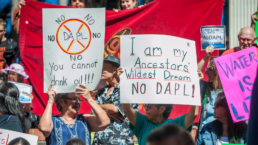
And at the state level, in part responding to the protests against the Dakota Access Pipeline, lawmakers in at least 17 states have passed legislation to increase jail terms and monetary penalties for offenses such as vandalizing and tampering with so-called critical infrastructure. In recent years, nonviolent climate protesters have been charged with trespassing, theft, and terrorism.
At issue in Reznicek’s case is whether her conduct was “calculated to influence or affect the conduct of government by intimidation or coercion, or to retaliate against government conduct.” Prosecutors in the case argued that Reznicek’s conduct fit this description because she held a press conference in front of the Iowa Utilities Board office and used a crowbar to dismantle an Iowa Utilities sign.
“They were trying to say to the government, ‘If you do this kind of thing, we’re going to go out there and take the law into our own hands and end the pipeline one way or the other,’” the government prosecutor said at the hearing. “That is incredibly dangerous and exactly what this enhancement is designed to stop.”
Robert Richman, Reznicek’s attorney, argued that her actions did not target the Iowa Utilities Board and that her statements and actions did not indicate she tried to “influence” or “retaliate” against the agency. “There’s no question that Ms. Reznicek was unhappy with the decision of the Utility Board to allow the pipeline, but the damage to private property was calculated to stop the pipeline, not to punish the board,” he said.
In a 2021 statement to the court, Reznicek, who has long been associated with the Catholic Worker Movement, which promotes a social-justice oriented interpretation of Catholicism, said she is “not a political person” and “certainly not a terrorist.”
“I am simply a person who cares deeply about an extremely basic human right that is under threat: Water,” she wrote.
The appellate court is expected to issue a ruling in the coming weeks.
Recent Posts

Why Ro Khanna and AOC Should Run for President in 2028
Take Action Now This week, RootsAction teamed up with Progressive Democrats of America to announce that we will jointly launch, just after the…
‘Proven Leaders and Voices of Clarity’: Progressives Urge Ocasio-Cortez and Khanna to Enter 2028 Presidential Race
Take Action Now “AOC and Khanna… have shown a willingness to blaze unusual and much-needed trails on Capitol Hill beyond the constraints of the…

‘Hit the Brakes’: Anthropic CEO’s Push to ‘Pace’ AI Development Called Latest Sign Congress Must Act
Take Action Now “When the future of humanity is at stake we need a PAUSE on advanced AI development and a ban on artificial superintelligence,” said…

Accountability for the Gaza Genocide Can’t Focus on Netanyahu Alone
Take Action Now Getting rid of one bad leader won’t bring justice.By Jeet Heer, The Nation On Thursday, former US Secretary of State Hillary…