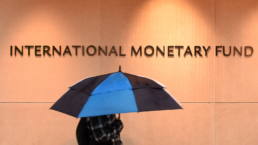
The International Monetary Fund (IMF) claims to help countries in need, but in reality helps enforce austerity worldwide.
By David Adler, The Guardian
This week, the board of governors of the International Monetary Fund (IMF) will gather at its headquarters in Washington DC to reaffirm the Fund’s three-part mandate: financial stability, economic strength, and – as its managing director, Kristalina Georgieva, recently asserted – international solidarity. “I am determined that we will support our members however we can,” Georgieva said of the Fund’s new spirit. “Now is the time to take advantage of this opportunity to build a better world.”
Georgieva is right: it is now or never. The “largest spate of debt crises” in a generation hangs over the global south. Two ingredients compose this ticking debt bomb: rapidly rising levels of public debt among the world’s poorest countries, and a rapidly rising percentage of that debt issued at variable interest rates. The combination of these two ingredients mean that even minor rate hikes in rich countries will have explosive consequences across the developing world – just as supply chains seize, food prices soar and the Covid-19 pandemic rampages through the world’s under-vaccinated populations.
In short, the global south has never needed more support in its search for stability, strength and solidarity. But even a cursory glance of the IMF’s global activity reveals a systematic violation of this mandate, inflaming – rather than resolving – the crises of health, hunger and habitat that combine in the world’s poorest countries.
Consider Argentina. In 2018, the IMF ignored warnings from its own staff to push through a $57.1bn loan to the Republic of Argentina under President Mauricio Macri: the largest loan in the history of the Fund. Did the loan deliver on the IMF’s mandate of financial stability? The opposite: inflation rose, employment fell and capital fled the country at record rates. Now, well after Macri has been evicted from office, the people of Argentina continue to pay the price. Argentina’s economy minister, Martín Guzmán, put it bluntly in his letter to Georgieva last month: “None of the objectives of the program were achieved.”
Recent Posts
“Propaganda Show”: IDF Raids Palestinian NGOs in the West Bank Ahead of Israeli Elections
Take Action Now “The raid onto the city center Ramallah is not a lonely activity. It happens every day that they raid different villages,…

ICE Planning $100 Million ‘Nightmare’ Domestic Spy Program
Take Action Now Under ERO ONE, Immigration and Customs Enforcement plans to hire 142 intelligence contractors with top secret clearances and deploy…
Postpone the AI Public Offerings Until Congress Acts
Take Action Now A company should not disclose a risk of catastrophe to humanity and then sell its shares to the public before any public authority…
Congress Has The Power to Fix the Trump-Saudi Nuclear Deal
Take Action Now Congress has at least 9 months and considerable leverage to make things right.By Alan J. Kuperman, Bulletin of the Atomic…