
What is presented as a uniquely “Russian” type of warfare, with high civilian casualties, is not dissimilar from attacks by the U.S. and its allies. Let us examine the facts that challenge our narratives in addition to those that confirm them.
Nathan J. Robinson, Current Affairs
he New York Times has an article attempting to explain to readers why the Russian military is committing indiscriminate atrocities in Ukraine. The Times tells us that Russia’s “experience in a string of wars led to the conclusion that attacking civilian populations was not only acceptable but militarily sound,” and even calls this a “Russian Way of War.” The article cites Russia’s experience in three previous wars (Afghanistan, Chechnya, and Syria) and claims that these experiences inform a kind of “playbook” in which Russian attacks on civilians have become “increasingly standard practice.” The message of the piece is unmistakably that while we in the West may care about human rights and civilian lives, Russia has become a brutal country that is willing to commit war crimes in order to achieve its military objectives. The article even provides chilling quotes from a Russian politician and military analyst who appears to argue in the most cold-blooded way that the ends justify the means:
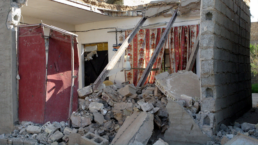
They also reflect the circumstances of an authoritarian state with few allies, enabling the Kremlin to ignore and even embrace revulsion at its military conduct — or so Russian leaders seem to believe. “Massive devastation and collateral fatalities among the civilian population are acceptable in order to limit one’s own casualties,” Alexei Arbatov, a prominent Russian military strategist and at the time a federal legislator, wrote in 2000, during Russia’s second war in Chechnya. “The use of force is the most efficient problem solver, if applied decisively and massively,” Mr. Arbatov wrote, adding that international horror at Russian actions should be “discounted.”
Arbatov’s words are disturbing. When I read them, I wondered how anyone could possibly say something so psychopathic, and I was curious about what the context for them might be. The link goes to a paper published by the George C. Marshall European Center for Security Studies on the subject of “how the Yugoslav war destroyed remaining hopes for genuine security partnership and military cooperation between Russia and NATO.” The quotes cited by the New York Times appear in the executive summary. Below is the full passage they are taken from, with the quotes the Times used in bold:
The use of North Atlantic Treaty Organization (NATO) aircraft and missiles against Serbia on March 24, 1999 ended the post–Cold War phase of international affairs. The Serbs conducted ethnic cleansing against the Albanians on an unprecedented scale, but these attacks escalated after the initiation of the NATO air campaign. The attack on Serbia suddenly removed a Russian taboo against the use of military force that followed the first war in Chechnya of 1994–1996. NATO’s military action was a final humiliation and a “spit in the face” for Russia, which more than ever before demonstrated the Western arrogance of power and its willingness to ignore Russian interests. Russia has learned many lessons from Kosovo. Above all, the end justifies the means. The use of force is the most efficient problem solver, if applied decisively and massively. Negotiations are of dubious value and should be used as a cover for military action. International law and human suffering are of secondary significance in achieving the goal. Massive devastation and collateral fatalities among the civilian population are acceptable in order to limit one’s own casualties. Foreign public opinion and the position of Western governments are to be discounted if Russian interests are at stake.
Now, I have to say, I don’t think any honest person, reading Arbatov’s full monograph, can claim the New York Times represented him fairly…
Recent Posts
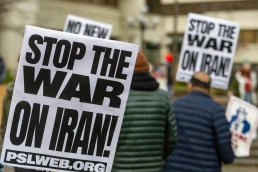
Take Action October 20 to End the Illegal U.S.-Israeli War on Iran, #PeaceWithIranNOW
Take Action Now The war is not just illegal, but massively unpopular with the U.S. public, and Trump and his Republican enablers may take a deserved…
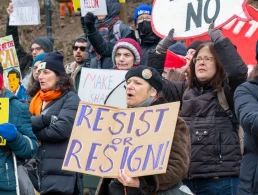
Chuck Schumer Hasn’t Said a Word About Trump’s Attempt to Deport Ilhan Omar
Take Action Now Ethics lawyers say the raid violated the Hatch Act. Schumer has been silent.By Sharon Zhang , Truthout Days after the Trump…
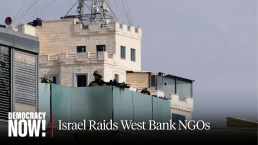
“Propaganda Show”: IDF Raids Palestinian NGOs in the West Bank Ahead of Israeli Elections
Take Action Now “The raid onto the city center Ramallah is not a lonely activity. It happens every day that they raid different villages,…

ICE Planning $100 Million ‘Nightmare’ Domestic Spy Program
Take Action Now Under ERO ONE, Immigration and Customs Enforcement plans to hire 142 intelligence contractors with top secret clearances and deploy…