
Democrats are reportedly considering a new Ukraine aid package of up to $15 billion, even as Trump has requested no new Ukraine funding in his 2027 military budget.
By Medea Benjamin and Nicolas J. S. Davies
As Democrats prepare to take control of Congress in January, they face a critical choice on Ukraine: Will they help bring an end to a devastating war that is killing and wounding hundreds of thousands of people, or will they double down on a failed strategy of sending more weapons, pouring billions more dollars into the war, and rejecting opportunities for diplomacy?
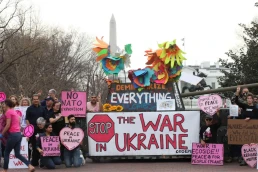
While Trump has renewed efforts to seek a negotiated solution to the war, which he had promised to solve on the first day of his second term, Democrats in Congress appear ready to reject diplomacy and increase support for the war. The likely incoming House committee chairs Gregory Meeks (Foreign Affairs), Adam Smith (Armed Services) and Jim Himes (Intelligence) have pledged legislation to compel Trump to provide greater military, economic and intelligence support to Ukraine.
Democrats are reportedly considering a new Ukraine aid package of up to $15 billion, even as Trump has requested no new Ukraine funding in his 2027 military budget. The effort has bipartisan backing, with Republicans such as Rep. Joe Wilson and Sen. Roger Wicker pushing for continued military aid and tougher sanctions on Russia. Congress could also seek to reverse Trump’s easing of sanctions, setting up a confrontation over whether Washington should increase pressure on Russia or prioritize a negotiated settlement.
Meanwhile, a new series of talks between the U.S., Russia and Ukraine began in Abu Dhabi on November 10 and 11. As in previous talks, they agreed on another prisoner exchange, but there was no breakthrough on ending the war.
As Ukraine suffers mounting loss of life, widespread destruction and economic devastation, Russia bears full responsibility for launching its illegal invasion and continuing its brutal attacks. NATO leaders, whose military officers shape and support Ukraine’s war strategy from their joint headquarters at the Wiesbaden US air base in Germany, blame the ongoing conflict solely on Russia, relying on a thick fog of propaganda to evade accountability for their own roles in Ukraine’s destruction.
When the Democrats take charge in Congress, they will find that neither President Zelenskyy nor his European allies have budged from the no-negotiations policy that the Biden administration and then British prime minister Boris Johnson pressured Ukraine and NATO into adopting in April 2022. After only six weeks of war, Johnson marched into Kyiv and told Zelenskyy to stop negotiating with Putin and commit to a long war, with the ill-defined goal of “weakening” Russia.
Johnson persuaded Zelenskyy to abandon peace talks in Istanbul, where Russia had already agreed to the broad terms of a Ukrainian peace proposal. Falsely claiming to speak for the “collective West,” Johnson refused to back any agreement with Russia, and promised Zelenskyy that the UK was “in it for the long run.”
Four and a half years later, some responsible party in the western world must fess up to the reality that this policy has failed miserably, militarizing and strengthening Russia instead of weakening it. Then they must take a fresh, unbiased look at where the war stands and what can be done to end it, if they are to save the Ukrainian people from the catastrophe of a brutal war of attrition fought to the bitter end. It is one thing to condemn Russia for launching a devastating war; it is quite another to prolong that war in an effort to punish Russia, at the cost of countless Ukrainian lives.
According to an October Rating Group poll reported by the Ukrainian news agency UNN, more than 80% of Ukrainians now support a negotiated peace with Russia, while 56% say they would agree to territorial concessions if they are linked to security guarantees. Only 21% now support an unlimited war to try to restore Ukraine’s pre-2014 borders.
Former UN Assistant Secretary General Michael von der Schulenburg, now a European Member of Parliament from Germany, is warning that Ukraine is close to collapse, and that the US and Europe’s refusal to face that reality risks making the final stages of the war even more disastrous.
While Ukraine has inflicted serious damage inside Russia, including destroying a major section of the Kerch Strait bridge between Russia and Crimea, Russia has intensified its attacks on bridges across the Dnipro River, which could effectively cut Ukraine in half. Russia is methodically destroying Ukraine’s energy and transport infrastructure, and has closed the port of Odesa, the main outlet for Ukraine’s exports. If Ukraine should permanently lose Odesa, it would be left with no port on the Black Sea for its main exports of grains and cooking oil.
War casualties, mass flight from the country and territorial losses have already reduced Ukraine’s population from 52 million in 1992 to probably less than half that today. A violent, climactic end to the war would trigger a new exodus. Instead of millions of women and children returning to rebuild their shattered country, young men whom martial law has prevented from leaving will finally leave to join family members in their new lives abroad.
European officials also held talks with the US and Ukraine on November 10th, but without Russia, before meeting again with President Zelenskyy at a European summit in Dublin. Kaja Kallas, the EU’s unelected High Representative for Foreign Policy, declared the new negotiations dead-on-arrival, telling Reuters, “So far they have just been pretending that they negotiate because we haven’t seen any goodwill from the Russian side.” Kallas hasn’t shown any goodwill either, and is still clinging to Biden and Johnson’s playbook, preemptively rejecting any chance for diplomacy.
But some of Europe’s elected leaders are rightly wary of Kallas’s virulent Russophobia and militarism, and have refused to appoint her as the sole EU representative to the new round of talks. Many of their populations are in open revolt against huge increases in military spending, since NATO agreed to Trump’s demand that each NATO country should spend 5% of GDP on its military, although many of them had not even met its previous 2% target. Only the socialist government of Pedro Sanchez in Spain has explicitly rejected any increase in military spending for Trump’s new arms race in Europe.
Meanwhile, on November 18, the European Commission proposed a new $49 billion aid package for Ukraine for 2027 – $27 billion in military aid and $22 billion in budgetary support. But Bulgaria, Hungary, Czechia and Slovakia have already announced that they won’t contribute, and Poland has ruled out further contributions to a separate NATO program that buys weapons for Ukraine.
As the public in Europe take to the streets demanding that their taxes be spent on healthcare, housing and education, not on weapons and war, their leaders smugly claim that they are funding, and in some cases participating actively in the war in Ukraine to enforce the UN Charter and international law.
US allies watch mostly in silence as the United States routinely violates Article 2(4) of the UN Charter, which prohibits the threat or use of force against other countries. Yet they treat Russia’s violation of the same article against Ukraine as justification for an endless, bloody war, sacrificing a generation of Ukrainians, but not their own young people.
But the UN Charter’s Article 2(4) is not a blank check for endless war. Quite the opposite. US and European leaders must also comply with Article 2(3), which commits all countries to resolving their disputes peacefully, and Article 33, which spells out that obligation in more detail.
This commitment to the “pacific resolution of disputes” is the basis for the prohibition on the threat or use of force. Nowhere does the Charter say that Articles 2(3) and 33 cease to apply once another country has violated Article 2(4). To interpret the Charter that way would be a recipe for endless war, which is precisely what the West’s deliberate misinterpretation of the Charter has led to in Ukraine.
Russia’s guilt for its aggression against Ukraine does not absolve Western leaders for their own violations of the UN Charter. Illegally rejecting negotiations and diplomacy in favor of prolonging a war Ukraine cannot win militarily, they have sacrificed Ukraine and its brave people on the altar of their geopolitical ambitions, as they have done to countless other countries.
But there is also a political price to pay for perpetuating endless wars. Even Trump and Vance have admitted that their illegal war on Iran lost the election for the Republicans, and Americans did not vote to end one illegal war in order to escalate another. Those who are old enough to remember 2008 can recall how Barack Obama was hailed as a peace candidate because he promised to end the US war in Iraq, but then escalated the US war in Afghanistan, prolonging it for another 13 years.
Did Obama’s party learn nothing from that experience? Will the Democrats now make a similar miscalculation in Ukraine? Or will they listen to voices urging peace and diplomacy, like the war-wise veterans in the Eisenhower Media Network and Veterans for Peace?
A post-election Reuters/Ipsos poll published on November 10th shows that US voters have connected the dots between the war on Iran and their own economic problems. They want their government to reorient its priorities from wars overseas, support for Israel and record military spending to the neglected needs of working Americans. Most of the American public now see through the false narratives that support corrupt oligarchic policies, from billionaire tax breaks to genocide in Palestine and war on Iran.
The Ukraine war has faded from the headlines, but a Democratic effort to provide more war funding or escalate the war could bring it back into the spotlight, prompting millions of Americans to ask the same hard questions about Ukraine that they have been asking about Israel and Iran. Here are a few such questions, and some sources that can help to answer them.
How did NATO expansion betray US commitments to Russia, revive the Cold War and lead to war in Ukraine, as veteran US diplomats warned that it would? See prescient warnings by George Kennan, the Arms Control Associationand Ambassador to Moscow (later CIA Director) William Burns.
How did the violent overthrow of Ukraine’s elected Yanukovich government in 2014 lead to the disintegration of Ukraine? See a June 2014 Gallup poll in which only about 50% of the population of Ukraine recognized the new government as legitimate, and the deadly violence of the Right Sector militia and right-wing Svoboda party against Ukrainians who rejected the US-backed regime change.
How did the 2015 Minsk II Accord succeed in deescalating the post-coup civil war, but fail to resolve Ukraine’s political divisions? See this interview with former OSCE ceasefire monitor Benoît Paré, who explains that pro-Ukrainian government forces were responsible for nearly three-quarters of the civilian casualties in Donbas between 2016 and 2018, as Ukraine shifted from granting autonomy to Donbas, which it agreed to in Minsk, to planning to take it back by force, with NATO support, weapons and training.
What was the Istanbul agreement of March 2022, and why did Ukrainian negotiators celebrate its success but then abandon it at the insistence of the US and UK? The then Israeli prime minister Naftali Bennett and former German Chancellor Gerhard Schroder were both involved in those negotiations, and have given consistent accounts of the US role in blocking them.
And what of the West’s endless claims that Russia is always just on the verge of defeat in Ukraine, despite President Zelenskyy warning that Russia has ten times the artillery and 30 times the airpower of Ukraine? Can we believe Ukrainian and Western claims that Russia is suffering more casualties than Ukraine, despite this huge imbalance in the explosive weapons that cause the most casualties: bombs, missiles, drones and artillery shells? See this interviewwith Alexander Grable, a researcher in the Department of War Studies at King’s College, London.
Despite the dense fog of propaganda from all sides, it is clear that Ukraine cannot defeat Russia, which means it will not militarily recover all the territory it has lost since 2014. In any case, large majorities in Crimea, Luhansk and Donetsk already voted to secede from Ukraine. But a peace agreement could include internationally recognized referenda in those areas, maybe even with a choice between autonomy within Ukraine (as in the Minsk Accords) and international recognition as provinces of Russia.
Russia has occupied more territory since the US and UK undermined the Istanbul agreement in 2022. But that lost chance for peace shows that agreement is possible. The longer this war goes on, the greater the scale of death and destruction will be, and the more precarious the future that Ukraine will face when it finally ends.
The new Democratic leaders in Congress will have a chance to “seize the moment,” as General Mark Milley, then the Chairman of the US Joint Chiefs of Staff, implored Biden and Zelenskyy to do in November 2022, after a successful Ukrainian counteroffensive led to a Russian withdrawal from the city of Kherson. Tragically, General Milley was ignored.
If the Democrats want to seize this new moment to make peace, General Milley, now a Distinguished Fellow at Georgetown University’s School of Foreign Service, would be a more serious choice as a US negotiator than Jared Kushner and Steve Witkoff, who are real estate developers, not diplomats.
Neither Trump and his real estate brokers nor Europe’s unpopular leaders can act as impartial mediators, since their countries are all parties to the war. We would much prefer to see the UN and the OSCE (Organization for Security and Cooperation in Europe) step in to conduct legitimate multilateral diplomacy rooted in international law, as they have done in other conflicts, and also to monitor any ceasefire, as the OSCE did in Donbas from 2015 to 2022.
But it is ultimately Russia and Ukraine that must make peace, regardless of who plays the role of mediator. The most important role the United States and its European allies can play is to support that process, not undermine it, as they did in April 2022, as European leaders are still doing, and as the Democrats in Congress risk doing too, if they try to resurrect Biden’s failed playbook.
It’s a measure of the futility of this war that the peace plan the US and UK torpedoed in April 2022 still offers a basic model for what both sides may be willing to accept in a new peace agreement. The essence of the plan was simply to agree that Ukraine will not join NATO and will be a neutral country, like Austria during the “old” Cold War; not a battleground between East and West, but a bridge between them that can reap the benefits of trade and political and cultural connections with both.
But first, Ukraine must have peace, and we urge the new Democratic majority in Congress to seize the moment.
Medea Benjamin and Nicolas J. S. Davies are the authors of War In Ukraine: Making Sense of a Senseless Conflict, now in a revised, updated 2nd edition.
Medea Benjamin is the cofounder of CODEPINK for Peace, and the author of several books, including Inside Iran: The Real History and Politics of the Islamic Republic of Iran.
Nicolas J. S. Davies is an independent journalist, a researcher for CODEPINK and the author of Blood on Our Hands: The American Invasion and Destruction of Iraq.
Recent Posts
The cost of loyalty: Kamala Harris’s legacy on Gaza will haunt her in 2028
Take Action Now Harris cannot realistically hope to wipe the political slate clean. Her handling of the Gaza issue was far more than simply a…

Establishment Dems Want to Renew Trump’s Domestic Spy Powers Before New Congress
Take Action Now Rep. Jim Himes and Sen. Mark Warner are spurning the will of midterm voters by pushing warrantless spying in the lame-duck Congress,…

Channeling Blue Waves Into Rivers of Progress
Take Action Now Progressives are about to be sandwiched between Trump fascism and the Blue-nami’s corporate undertow that threatens to drown change.……

The Dark Money Machine Shaping Democrats’ Mandate
Take Action Now Banks, cryptocurrency firms, and the Israel lobby poured millions into super PACs tied to Democratic caucuses. Now those groups are…