
The Democratically controlled Congress must go further than just war powers resolutions, an ex-Biden official says.
By Sharon Zhang, Truthout
Voters across the U.S. overwhelmingly rejected the Trump administration’s war on Iran on Tuesday, putting their faith in Democrats who now wield enormous power to end the war — and to prevent future wars from being started unilaterally by a figure like Donald Trump ever again.
The historically unpopular war and its economic consequences were among the top reasons for Republicans’ collapse. Gallup polling last month found that the economy, the Iran war, and gas prices were three of the top five issues that voters rated as “extremely” or “very” important to their vote. Countless Democrats ran on a platform of ending the war. Its impact was so undeniable that Trump and Vice President JD Vance openly admitted as such in statements following the election. In a long X post analyzing the situation on Wednesday, Vance said: “[T]he real reason we lost is obvious to almost everyone…. The reason we lost is the war.”

But it’s not just the war on Iran, as Vance acknowledged. The result was also a rejection of the U.S.’s unwavering support for Israel; Trump seemed to understand as much when he made his last-ditch announcement on Tuesday morning that the U.S. is ending its annual $4 billion funding to Israel, in favor of other deals.
“This was a foreign policy election,” said Harrison Mann, a former senior officer for the Defense Intelligence Agency’s Middle East/Africa office who resigned from the Biden administration in protest of its backing of the genocide in Gaza. Mann currently serves as associate director for Policy & Campaigns at Win Without War.
In an interview with Truthout, Mann laid out the imperative that Democrats have to deliver on the anti-war mandate that they’ve been handed. And they must, he said, if they wish to restore the public’s faith in the democracy that Trump has worked vehemently to erode.
Right now, Democrats “need to prove to voters that voting actually works,” he said.
“This was an election that Democrats largely won due to voters’ opposition to the Iran War, to U.S. support for Israel’s crimes against Palestinians,” said Mann. “If they cannot demonstrate that they can deliver on these issues, they’re going to risk losing that mandate. And they’re going to leave — however disingenuously — they’re going to leave the anti-war window open to JD Vance or whoever runs for the Republicans in 2028.”
Democrats and Republicans have been kicking the anti-war message back and forth for decades. President Barack Obama ran on opposing the invasion of Iraq; Trump against the Iraq invasion and as a “candidate of peace” in 2024. It was an easy tack to take against Joe Biden, who, with Kamala Harris, fueled Israel’s genocide in Gaza, and who himself ran on a platform that included opposition to the war on Afghanistan.
But each president subsequently started their own conflicts, stretching the executive branch’s powers and circumventing Congress’s statutory authority over war. This impunity has allowed people like Trump to start the disastrous war on Iran without congressional approval — and, in fact, in defiance of war powers resolutions that have passed the House and Senate.
Democrats have the tools to change that. Symbolic measures like passing war powers resolutions can help expose contradictions in the Trump administration’s actions, and have support from incoming freshmen like Michigan Senator-elect Abdul El-Sayed.
The real levers of power, however, lie in Democrats’ ability to manipulate budgets to kill Trump’s agenda if he continues the Iran war — or any of his other conflicts, like his sanctions regime on Cuba or his boat strike campaign.
One option is “defunding Trump’s war machine and War Department,” Mann said.
Pursuing an anti-war agenda requires Democrats to not unquestionably pass the ever-growing Pentagon budget, and even working to shrink the Trump administration’s record $1.5 trillion military budget request.
On the Iran war specifically, Democrats could include a provision to bar military funding from being used for the Iran war. But, given the foreseeable circumstance in which the Trump administration would simply ignore that requirement, Democrats could also force a government shutdown or withhold Pentagon spending altogether unless Trump withdraws troops from the region.
“The serious leverage is not funding the Pentagon at all until you have some guarantee. Though I wouldn’t accept the guarantee until you see Trump withdrawing from the theater,” Mann said. “Because really, short of that, you are not actually exercising leverage over the administration.”
Democrats also have leverage over the sanctions that have choked Iran’s economy and its population. Mann pointed out that lawmakers can introduce legislation that lifts sanctions while framing it as a way of reopening the Strait of Hormuz, since sanctions relief has been a major demand of the Iranian government in negotiations to end the war.
Such bills could be considered alongside accountability measures for the Trump administration, including the impeachment of Defense Secretary Pete Hegseth and hearings against those who have acted on the administration’s wide-ranging, often illegal military fronts.
After that’s done, Democrats can even look to the future. They can start to introduce legislation to make it harder for future presidents to declare unilateral power over starting wars through “extensive national security reforms,” Mann said.
This will require a boldness from Democrats that many in the U.S. have grown accustomed to not seeing. Ahead of the election, outlets like Politico were already encouraging Democrats to hedge on ending the Iran war, or else be labelled pro-Iran.
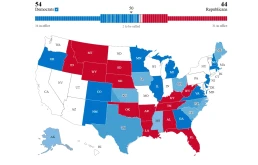
But Democrats are poised to win 259 seats to Republicans’ 176 in the House. They’ve already won 54 seats in the Senate, and may pick up two more by the time all votes are counted, rendering majority-spoiling figures like Sen. John Fetterman (D-Pennsylvania) completely moot.
“The mandate that Democrats were just handed by Trump is going to be squandered if they continue to operate under the fear of being bullied by Republicans, if they continue to calculate Republican name calling into their policy making. Ultimately, you couldn’t have a clearer mandate from this election that American voters do not care about being tough on Iran,” said Mann. “They would just like a solution that delivers for them.”
Recent Posts

Van Hollen Says No Rubber Stamp for Schumer as Majority Leader Without Support for ‘Bold Agenda’
Take Action Now “It’s not a time for incrementalism,” said Sen. Chris Van Hollen. “It’s a time to move forward a very bold kitchen table agenda.”…
Let’s Not Let 2026 Elections Turn Out Like 2006 Elections
Take Action Now This is the most important part of elections: the demand for follow-through, the organized nonviolent agitation and pressure for…
The Progressive Revolt Stops At Hakeem Jeffries
Take Action Now The Democratic left bets it can win more by working with the House Speaker. That could cost them.By Katya Schwenk, Luke Goldstein,…

U.S. Sharing Nuclear Technology With Saudi Arabia Is a Bad Deal
Take Action Now This is an obvious, preventable step toward the proliferation of nuclear weapons.By Emma Claire Foley This July, the U.S. and…