This is an obvious, preventable step toward the proliferation of nuclear weapons.
By Emma Claire Foley
This July, the U.S. and Saudi Arabia signed a civilian nuclear agreement, giving the Saudis access to the U.S. nuclear technology they would need to build their own civilian nuclear program.
This is an obvious, preventable step toward the proliferation of nuclear weapons.
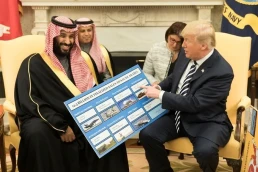
The deal started under the first Trump administration, as part of an attempt to re-order the political status quo of the Middle East to the U.S.’s liking. Under that agreement, Saudi Arabia would formally recognize the state of Israel in exchange for access to U.S. nuclear technology.
Two years into Israel’s campaign to wipe out Gaza, that recognition is no longer on the table, and the final deal falls short of the safeguards and diplomatic measures required by U.S. law. Agreements like these are required to include provisions for International Atomic Energy Act (IAEA) inspections of all nuclear sites in the country through a so-called “123 Agreement.” But the bilateral agreement that has been substituted in this case includes no such provision, effectively allowing Saudi Arabia to maintain nuclear-weapons sites unbothered.
Just as the Trump administration has been reckless with U.S. nuclear weapons, it seems unbothered by the very real possibility–one repeatedly confirmed by Saudi leaders’ public statements that they would pursue a nuclear weapons program if Iran got the bomb–that it is actively fostering the emergence of a second nuclear-weapons country in the Middle East. (Israel has maintained a nuclear arsenal for many decades.)
*
Though the deal was conceived and concluded under two different Trump administrations, it has been a bipartisan project: the Biden administration continued to pursue the deal with legal safeguards added. Across U.S. administrations, there has been a decreasing interest in pursuing diplomatic solutions for political problems, an increasing tendency to regard nuclear proliferation as inevitable, and a prioritization of short-term “wins” aimed at cementing the U.S.’s geopolitical dominance relative to China over long-term global safety and stability.
That is one of the loudest supposed justifications for this bad deal. China has been actively involved in developing aspects of the Saudi nuclear project, developing its uranium mining and processing capabilities, providing support to its ballistic missile program, and holding out the possibility of a similar deal to provide more comprehensive nuclear power capabilities to the kingdom. Saudi Arabia has been able to use the U.S. and China’s increasing rivalry to its advantage: in 2011, its government announced that it planned to construct 16 nuclear power reactors within 25 years. In the rush to pursue a new business opportunity and cement political influence, the U.S. and China are placing the whole world at risk of what might happen with two nuclear weapons states in the Middle East.
*
The deal has been signed, but it’s not too late to stop this. As Alan J. Kuperman writes in the Bulletin of the Atomic Scientists, the deal violates the U.S. Atomic Energy Act, a law designed to facilitate the U.S. providing nuclear-energy technology to other countries. Joint Resolutions of Disapproval have been introduced in both the House of Representatives and the Senate calling for congressional review of the deal, which could slow or stop its enactment.
Further, Congress could take steps toward badly needed nuclear diplomacy with China, accepting that the two countries must collaborate to control the risk of nuclear proliferation and use. Acknowledging and controlling the dangers inherent in giving other countries access to nuclear-energy technology are essential elements of this imperative.
Contact your senators and representative now and tell them to sign on to the Joint Resolutions of Disapproval and to do anything they can to stop this deal: https://rootsaction.org/no-nukes-to-saudi-arabia
Emma Claire Foley is the Campaign director for Defuse Nuclear War and a Specialist in Nuclear Issues at RootsAction and RootsAction Education Fund.
Recent Posts
Government Corruption a Top Issue for U.S. Midterm Voters, Exclusive Poll Finds
Take Action Now Harris poll for Guardian finds 76% believe officials care more about self-enrichment than helping everyday AmericansBy Lauren…

Radical Centrists Like Haley Stevens Are the Real Extremists in the Democratic Party
Take Action Now By endorsing Abdul El-Sayed’s opponent for Israel’s sake, Stevens shows how the real threat to progress comes from centrists.By…
From ‘hope and change’ to MAGA fascism
Take Action Now He bailed out Wall Street financiers who helped create the Great Recession of 2008, allotting 700 million dollars of public money to…
Top Democrats are fighting a billionaire tax in California. Their voters are on the other side
Take Action Now The unprecedented measure has enormous potential nationwide. The clash exposes the party’s corporate-progressive divideBy Norman…