
Democracy Now! guests Anatol Lieven and William Hartung discuss tensions in Eastern Europe.
By Amy Goodman & Juan González, DemocracyNow!
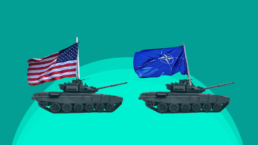
The U.S. has prepared some 8,500 troops to deploy to Eastern Europe in the event that Russia invades Ukraine, which Russian President Vladimir Putin denies is his goal. On Wednesday, officials from Russia, Ukraine, France and Germany are scheduled to meet in Paris to negotiate resolving the crisis. “The security of Europe ought to be principally Europe’s business,” says Anatol Lieven, senior fellow at the Quincy Institute for Responsible Statecraft. “This whole notion of great power competition, which is embedded in the National Defense Strategy, has been used as kind of the magic key to keep Pentagon spending at near-records levels,” says national security expert William Hartung, research fellow at the Quincy Institute.
Transcript
AMY GOODMAN: The Pentagon has placed 8,500 troops — up from 5,000 — on heightened alert to potentially deploy to Eastern Europe over concerns Russia may soon invade Ukraine. The U.S. and NATO allies have accused Russia of amassing 100,000 troops near the Ukrainian border, but Russia is denying it’s planning an invasion. Pentagon Press Secretary John Kirby spoke Monday.
JOHN KIRBY: Secretary Austin has placed a range of units in the United States on a heightened preparedness to deploy, which increases our readiness to provide forces if NATO should activate the NRF or if other situations develop. All told, the number of forces that the secretary has placed on heightened alert comes up to about 8,500 personnel. … But again, no mission has been assigned to these troops; no deployment orders have been sent to them. What the secretary has ordered them to do is to be ready to go in some cases on a much shorter tether than what they had before.
AMY GOODMAN: This comes as other NATO nations are planning to send additional troops, ships and fighter jets to Eastern Europe. Plans call for France to send troops to Romania, Denmark to send F-16 jets to Lithuania, and for the Netherlands to send F-35 jets to Bulgaria. Last week, the Biden administration gave Lithuania, Latvia and Estonia approval to send U.S.-made weapons to Ukraine. On Monday, the Kremlin accused the United States and NATO of escalating tension in the region.
DMITRY PESKOV: [translated] We are seeing statements from the North Atlantic Alliance about more troops, pulling forces and assets into the eastern flank. All of it is causing tensions to rise. I’d like to point out it is not because of what we, Russia, are doing; it’s all happening because of what NATO, the United States are doing and the information they are spreading.
Recent Posts
The Consequence of Lost Voting Rights Will be Massive Acts of State Violence
Take Action Now The death-cult mentality of US fascism has stumbled upon an ingenious epiphany – the tepid commitment of American voters can be…
Democratic Voters Say They Want Change, But the Party Just Elevated More Hawks
Take Action Now Party leaders are ignoring the three-quarters of registered Democrats who oppose providing military aid to Israel.By Stephen…
The U.S. Bombed a Wedding in Iran. It’s Not the First Time
Take Action Now The Iranian Red Crescent Society has asked the International Criminal Court to investigate the U.S. strike, saying that if the…
25 Years Ago, 9/11 Triggered a U.S. Crusade of Torture
Take Action Now But in spite of the voluminous evidence that documented high-level approval of methodical torture, not a single U.S. official went to…