
Is Zionism simply a desire for Jewish self-determination and statehood in an ancestral homeland? Or is Zionism a colonial project to violently impose a Jewish state on a subjugated Palestinian population?
By Marcy Winograd, The Hill
As a retired public high school teacher and Jewish peace advocate, I was excited to co-organize a summer series titled “Challenging Zionism in Schools.”
Our series of four workshops — which was noticed and not appreciated by a recent oped writer — was designed to challenge existing indoctrination embedded in the curriculum, which conflates criticism of Israel with antisemitism in an effort to censor teaching and learning.
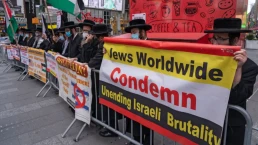
I have tried to set the record straight by testifying before school boards to clarify that antisemitism is bigotry toward Jews for being Jewish, whereas anti-Zionism is political opposition to a nation-state. To conflate the two risks the safety of Jewish people around the world who may be unfairly blamed for Israel’s militarism, including what Amnesty International and the United Nations Independent Commission of Inquiry have labeled Israel’s “genocide” in Gaza.
To teach students that anti-Zionism can be labeled as “contemporary antisemitism” borders on antisemitic tropes. It stereotypes Jews as monolithically supporting the state of Israel. Furthermore, such conflation threatens to rob our students of the opportunity to critically examine Zionism.
Is Zionism simply a desire for Jewish self-determination and statehood in an ancestral homeland? Or is Zionism a colonial project to violently impose a Jewish state on a subjugated Palestinian population?
Critical analysis should never be off-limits. To break the silence, our CodePink web series presented a lesson from Dr. Maha Nassar, a professor in Middle Eastern studies, who explained that the chant ”From the River to the Sea” is not antisemitic, but liberatory for Palestinians who either long to return to their homeland or live under Israeli military occupation.
This same workshop included the standards-based lesson South Africa v. Israel at the International Court of Justice, in which students read about that court, the U.N. Genocide Convention and competing texts in support and opposition to South Africa’s genocide case against Israel. The students then compose an argument to answer the prompt: Does the situation in Gaza meet the strict legal definition of genocide?
Another standards-based lesson we presented was a school board debate on the International Holocaust Remembrance Alliance definition of antisemitism and its attendant examples. Students had to convince their local school board members either to adopt or reject this definition, which centers criticism of Israel in its examples of antisemitism.
Both lessons presented multiple perspectives to engage students in rigorous debate that requires students to refute opposing views. This taps into higher-level thinking skills, problem-solving, analysis, evaluation, and synthesis. Both lessons incorporated national literacy standards to write arguments and support claims with evidence.
As an elected representative to the governing body of United Teachers Los Angeles, which represents more than 30,000 educators, I was proud to support our union’s motion to host a workshop on antisemitism with a professional organization that teaches antisemitism is a “historically contextual form of oppression linked to other systemic injustices.” This allows us to honor all struggles against bigotry and persecution as we refuse to exceptionalize a single form of discrimination.
Recent Posts

Trump Says He Is in ‘Deciding Mode’ on Destroying Iran
Take Action Now The Pentagon’s own death count is undercounting US troops killed in the seven-month war, the Washington Post has reported.By…

In the Age of AI, Nuclear Weapons Abolition Is a Renewed Imperative
Take Action Now As long as we have nuclear weapons, the job of ending humanity will continue to be as easy as the push of a button—or an AI agent…

Why Do We Let Zionists Decide What We Can and Can’t Say?
Take Action Now Kraft is a man who appears in the Epstein files, was twice caught on camera with prostitutes, donates heavily to the IDF, and even…

Trump Says He’s Banning CNN, MS NOW, and Politico From the White House
Take Action Now “These outrageous attacks only demonstrate how scared he is of an informed public,” said one press freedom advocate.By Stephen…