
Nine months into this so-called ceasefire, the wounds of war are not only unhealed — they are still being inflicted.
By Doctors Without Borders (MSF)
Nine months after a ceasefire went into effect in Gaza, Palestinians are still pulling children from under the rubble. Families are still burying their dead. And the space in which 2 million people are expected to survive has shrunk to less than a third of the size it was three years ago. This is not a ceasefire; it is structural violence under a different name.
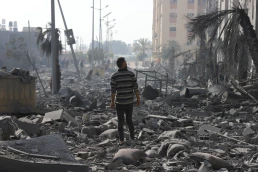
It is a continuation of the genocide, calibrated to be violent enough to keep Palestinians suffering every day, yet silent enough to avoid stirring international outrage. Under this “ceasefire,” people are still being killed and confined while aid is denied. It doesn’t dismantle the mechanisms of violence; it normalizes the continued disregard for Palestinian lives.
Amid this uncertainty and ongoing violence, Doctors Without Borders/Médecins Sans Frontières (MSF) continues to deliver lifesaving care. Our Palestinian colleagues continue to work under extreme conditions to run field hospitals, treat injured patients, provide mental health support, distribute water, and provide general health care to people in Gaza.
1. The killing has not stopped
A ceasefire should mean our emergency rooms are no longer filled with people wounded by war.
According to Gaza’s Ministry of Health, 1,185 Palestinians have been killed and 3,816 injured since the so-called ceasefire was announced on October 10, 2025. This is roughly one Palestinian killed or injured every hour and 20 minutes — for nine months straight. As of June 19, over 265 children have been killed since the ceasefire went into effect, according to UNICEF. Israeli forces continue to carry out daily strikes across Gaza, while continuously expanding their area of control.
For MSF staff in Gaza, the line between treating patients and becoming one is terrifyingly thin.
On July 16, an Israeli strike near an MSF clinic in Al-Mawasi sent four injured people to our teams. The following day, two apartment buildings housing our staff in Gaza City were struck without warning, trapping families inside as explosions shattered windows. In one building, rubble and bodies crashed into the lower-floor apartment of an MSF staff member.
The same day, MSF teams in Deir al-Balah, central Gaza, treated 12 people — seven of whom were children — who were injured after Israeli forces struck a funeral in Al-Nuseirat. In total, this strike killed eight people and injured 20. Among those killed was the 21-year-old son of an MSF staff member. Our colleague got the news while working in another emergency room.
These were not isolated incidents, but merely a snapshot of 48 hours in Gaza. Nearly two years after MSF established its field hospital in Deir al-Balah, and nine months after the ceasefire announcement, our teams are still receiving war-wounded patients.
2. The confinement of Palestinians has become another weapon
When the so-called ceasefire was announced, Israeli forces controlled roughly half of Gaza. Today, almost 2 million Palestinians are confined to approximately 30 percent of the Strip.
The “yellow line” [a boundary marking areas under full Israeli military control], which was negotiated as part of the ceasefire under the guise of safety, is now another mechanism of Israeli forces’ control and violence. It divides the Gaza Strip and confines Palestinians to an ever-shrinking area.
Just this week, one mother told our teams that her 14-year-old son, who has Down syndrome, was shot five times by Israeli snipers near the yellow line while he was playing near his home. The yellow line has become a moving boundary that confines people and exposes them to continued violence with impunity. It is neither clearly marked nor fixed, shifting westward whenever Israeli forces decide it should — without negotiation or warning, and with no right to expand.
Around 90 percent of people have been forcibly displaced, many of them multiple times, and most are living in overcrowded tents or makeshift shelters. Scabies, respiratory infections, rat bites, and other diseases are rife.
When strikes are not enough to force people out, overcrowding, disease, and deprivation are left to do the rest: a slower method of making the same third of Gaza unlivable for the people trapped inside it.
A ceasefire should ensure that hostilities are paused, weapons are silenced, and that people are safe from strikes across the Strip. Using it as a weapon of war and reinforcing the confinement to a fraction of Gaza cannot be justified.
3. Homes continue to be destroyed, and people forced to flee
The destruction of homes has not stopped with the announcement of the ceasefire. Sudden and arbitrary orders for people to flee their homes and shelters continue to be used as a tool of psychological warfare by Israeli forces. Repeated displacement and lack of security is not a consequence of the military campaign. It has become one of its defining features, ensuring that Gazans never feel safe regardless of a ceasefire.
By the time the ceasefire was signed, around 60 percent of Gaza’s population had already been made homeless, with roughly 77 percent of housing units damaged, most of those destroyed outright.
Roughly 1.9 million Palestinians had been forcibly displaced, often more than once. East of the yellow line controlled by Israeli forces, homes and entire neighborhoods continue to be leveled. West of the line, in the shrinking areas where Palestinians are confined, Israeli strikes continue to hit tents, shelters, and the few buildings still standing.
Today, almost a million Gazans live in tents or makeshift shelters, according to the Norwegian Refugee Council, most without reliable access to clean water, electricity, health care, or necessities. Yet Israeli forces continue to destroy what little shelter remains and issue so-called evacuation orders that force people to flee again.
Like everyone else in Gaza, our colleagues are often given only moments to leave when Israeli forces announce these displacement orders. They abandon what few belongings they have left, with nowhere safe to go. Even on nights without orders, uncertainty remains. Families go to sleep not knowing whether they will awake to another displacement order or another strike.
Recent Posts

New Polling: 84% Of Voters Support Van Hollen Resolution To Investigate Israel’s Killing of U.S. Citizens
Take Action Now 83% of Democrats, 86% of Independents, and 82% of Republicans back resolutionBy IMEU Policy Project Polling released Monday,…

Why Medicare for All Is Now Possible
Take Action Now The politics of health care are finally catching up with patients and physicians.By Rebecca Delay, The Progressive Across the…

According to Polls, Americans Like Socialism a Lot
Take Action Now A crop of recent polls shows that socialism’s appeal is surprisingly broad. They also reflect a transformed US political landscape…

Massive Ivanka Trump Problem Triggers Existential Threat to GOP: ‘Rage Is Building’
Take Action Now Locals in Albania — where Ivanka and her husband Jared Kushner plan to transform one of the nation’s most important ecological sites…