
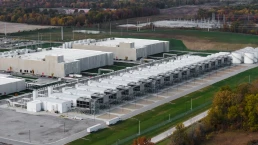
In the United States, there are between 1,500 and 1,600 data centers in the planning or construction phase, with over 4,000 already operating. A Pew study estimates that 67% of these new plants are coming to rural America, where 87% of existing centers currently operate in urban zones.
By Joshua Frank, CounterPunch
This week in the Anthropocene
The road is dusty and trash-strewn. My friend and collaborator Colby Groves is hanging out the car window as I drive, gazing at a patchwork of solar panels lined up behind a chain-link fence.
“This has to be it,” declares Colby, balancing a large camera on his lap, hoping it doesn’t bounce off as we traverse a series of bumps and divots.
We are in this land of scorching sun and heat, searching for a large Amazon solar installation in rural San Bernardino County, California. This is the home of the endangered desert tortoise and Joshua trees, but more recently, it’s become a plaything for greedy Silicon Valley entrepreneurs.
In 2024, Jeff Bezos’ Amazon connected its Baldy Mesa solar-and-storage project, which helps to power the company’s nearby data centers, to the electrical grid, earning accolades for its use of renewable energy. It’s the first of its kind in California. Despite its gargantuan size, the project faced very little opposition, as is often the case with such “green” projects.
As we step out of the car, we immediately hear the loud hum of a football-field’s worth of batteries, powered by solar panels that surround us in every direction. The entire setup is connected to the grid by towering transmission lines. Altogether, this sprawling array covers 1,500 acres of Mojave Desert habitat, almost twice the size of New York City’s Central Park.
Baldy Mesa’s impact on this delicate ecology is stark and tangible. Where Joshua trees once stood, Lego-like blocks of batteries the size of shipping containers now buzz and radiate heat. Where coyotes once scampered and desert tortoises burrowed, solar panels now blanket the landscape. Amazon avoided controversy by relocating 153 doomed Joshua trees, but the fact remains, there’s not a single Joshua tree where these photovoltaic panels now sit.
This particular Amazon Web Services (AWS) facility is an AI-driven machine-learning operation capable of analyzing 33 billion data points each year. That’s over 90 million data points a day. They claim it will allow their batteries to run more efficiently, while making you a better, wiser consumer of Amazon’s products and services.
As far as corporate marketing gimmicks go, this sure sounds nice. Yet, as I stand in the middle of Amazon’s solar farm, I can’t help but wonder what this desert must have been like before they decided it was better suited to powering AI programs. What was it like out here when the soil could still sequester carbon? Building on these lands has eliminated its ability to absorb fossil-fuel pollution. These solar panels are actually hurting the climate, not helping it out.
Even though this behemoth runs on renewable energy, nothing about it feels eco-friendly. Like so much of this AI-driven madness, there is a very post-apocalyptic aura to it all, made worse by the fact that Jeff Bezos is reaping the spoils.
“Wow, look at that.” Colby points to a fence set up to protect the battery installation. The gate is wide open.
Someone more inclined to commit sabotage would have no difficulty gaining access. But we aren’t here for data center mischief. Colby sets up his tripod to shoot footage to accompany Bad Energy, my forthcoming book exploring the downside of the so-called green energy transition.
Few people will ever make their way to this remote spot in the Mojave to witness firsthand what Amazon has wrought. Aerial photographs obscure the reality of what it’s like on the ground amid the AI upheaval being thrust upon us without our consent.
And, despite my many misgivings, this whole monstrosity is allegedly one of the better ones. Most new data centers aren’t powered by renewables but by fossil fuels.
Recent Posts
FACT SHEET: Trump’s Proposed $1.5 Trillion War Budget in Three Charts
Take Action Now Trump’s Pentagon hike would send war spending to nearly 70 percent of discretionary funds. Most would benefit weapons…

Israeli Settlers Killed His Constituent. Fetterman Is Sole Democrat Against Investigating Them.
Take Action Now Despite support from other Democrats, the Senate voted 51–47 against a resolution to force U.S. probes on killings of Americans in…

The Movement to Abolish ICE Is Gaining Momentum
Take Action Now As activists rally around federal legislation to dismantle ICE, Amnesty International joins the call for abolition.By Mike Ludwig,…

Wanted: An Organized Political Movement to Counter the AI Oligarchs
Take Action Now History teaches us that the American people are capable of building great movements against powerful corporate interests. Let’s hope…