
The current 10-day ceasefire between Israel and Lebanon has already shown signs of strain. While some displaced civilians have begun returning home, analysts warn that the underlying dynamics of the conflict remain unchanged.
By Staff, ScheerPost
A fragile pause in the widening Middle East war is colliding with escalating rhetoric, conflicting claims, and continued violence on the ground.
In a flurry of social media posts, President Donald Trump declared that the United States had directly intervened to halt further Israeli strikes on Lebanon.
“Israel will not be bombing Lebanon any longer,” Trump wrote.
“They are PROHIBITED from doing so by the U.S.A. Enough is enough!!! Thank you!”
The statement, issued amid a rapidly evolving ceasefire framework, suggests a level of U.S. leverage over Israeli military operations that officials and analysts have long debated—but rarely seen asserted so bluntly.
Yet even as Trump claimed de-escalation, events on the ground told a more complicated story.
Reports out of southern Lebanon indicated continued violence, including a drone strike that killed at least one person despite the announced ceasefire. Meanwhile, Israeli Prime Minister Benjamin Netanyahu signaled no intention of ending the broader campaign.
Israel is “not done yet” with Hezbollah, Netanyahu said, describing a strategy of pursuing both military pressure and political negotiation simultaneously.
Hormuz Reopens—But Under Pressure
At the same time, Iran announced that the Strait of Hormuz—one of the world’s most critical oil chokepoints—would be reopened to commercial shipping during the ceasefire period.
Iranian Foreign Minister Abbas Araghchi stated:
“Passage for all commercial vessels through [the] Strait of Hormuz is declared completely open for the remaining period of ceasefire.”
Trump quickly echoed the announcement, declaring the strait: “COMPLETELY OPEN AND READY FOR BUSINESS AND FULL PASSAGE.”
But the reopening came with contradictions. While signaling relief for global markets—oil prices reportedly dropped sharply following the news—the U.S. simultaneously maintained its military pressure.
“The naval blockade will remain in full force and effect … until such time as our transaction with Iran is 100% complete,” Trump said.
In other words: open waters, closed fists.
Conflicting Claims, No Clear Deal
Despite Trump’s sweeping declarations—including that Iran had agreed to “never close the Strait of Hormuz again”—there was no immediate confirmation from Iranian officials.
On the ground and in diplomatic channels, uncertainty remains the defining feature of this moment.
Negotiations are reportedly ongoing, with proposals for a temporary framework lasting several weeks. But key issues—including sanctions relief, uranium enrichment, and regional military activity—remain unresolved.
Even Trump appeared to acknowledge the disconnect, insisting:
“This deal is not tied, in any way, to Lebanon.”
That separation may be more rhetorical than real.
Ceasefire or Illusion?
The current 10-day ceasefire between Israel and Lebanon has already shown signs of strain. While some displaced civilians have begun returning home, analysts warn that the underlying dynamics of the conflict remain unchanged.
“Hezbollah will keep its ‘finger on the trigger’” if violations continue, one warning noted, underscoring how quickly the situation could unravel.
And with more than a million people displaced and thousands killed in recent weeks, the pause—however real or temporary—offers only limited relief.
A War Paused, Not Ended
What emerges from the past 24 hours is not clarity, but contradiction.
A ceasefire declared—and violated.
A waterway reopened—under blockade.
A bombing campaign “prohibited”—while leaders vow to continue fighting.
The language of peace is here. The reality of war has not left.
And as global powers posture over oil routes, naval blockades, and regional leverage, the question is no longer whether the conflict can pause—
—but whether anyone is actually in control of it.
As the U.S.–Israeli war on Iran spills across the region, a sudden ceasefire in Lebanon is being framed as a breakthrough—but the reality is far more unstable. Iran’s influence appears to have forced a pause on one front, reopening the Strait of Hormuz and easing global economic panic, while Israel signals it has no intention of ending its campaign against Hezbollah. At the center of it all is Donald Trump, claiming control over both escalation and restraint—yet presiding over a situation where bombs still fall and tensions continue to rise.
In this live discussion from Breakthrough News, analysts break down what’s really driving the ceasefire, how battlefield dynamics forced political shifts, and whether Washington is actually capable—or willing—to restrain Israel. Is this the beginning of de-escalation, or just a temporary pause before a wider war?
Recent Posts
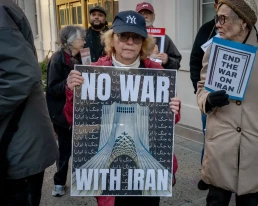
‘Stop The War on Iran’: Brooklyn Peace Activists Urge Jeffries to Help End Conflict
Take Action Now Democrats have a golden opportunity to capitalize on this issue, win big in November, and take real action on AI data centers to…

A Blue Wave Won’t Wash Away Our Oligarchy Problem
Take Action Now The massive election spending by Elon Musk and other billionaires is a huge problem, even if many of the superwealthy’s favorites…

Democrats Should Get Behind a National AI Data Center Moratorium
Take Action Now Democrats have a golden opportunity to capitalize on this issue, win big in November, and take real action on AI data centers to…

Another Way Out: Public Execution Is an Everyday Reality—Livestreamed or Not
Take Action Now For some, the Trump administration’s plan to livestream an execution was unacceptable because it wouldn’t happen behind closed doors……