
A “Uniting for Peace” resolution in the UN General Assembly can counter the Security Council’s failure to act.
By Marjorie Cohn, Truthout
Already 555 Iranians — including 180 students at a girls’ elementary school in Minab — have been reported dead in the war of aggression launched February 28 by President Donald Trump and his accomplice, accused war criminal Israeli Prime Minister Benjamin Netanyahu, against Iran.
“Operation Epic Fury involves the largest regional concentration of American military firepower in a generation,” U.S. Central Command said in a statement.
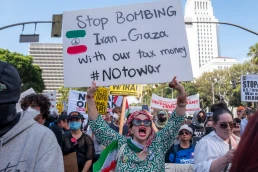
This aggression has destabilized the region and triggered Iran’s legitimate exercise of self-defense.
The U.S.-Israeli aggression against Iran violates the United Nations Charter, which requires that all states settle their disputes peacefully and refrain from the use of armed force except in self-defense under Article 51 after an armed attack against a UN state by another state, or when the Security Council authorizes it.
Before February 28, Iran had not mounted an armed attack against any country, nor did it pose an imminent threat to the U.S., Israel, or another UN member state. And the Security Council had not authorized the use of military force against Iran.
The timing of the U.S.-Israeli attacks undermines the pretext that the U.S. and Israel had been engaging in good-faith negotiations with Iran over its nuclear program.
Netanyahu Convinced Trump to Withdraw From the Iran Nuclear Deal in 2017
Trump claimed he attacked Iran to prevent it from developing nuclear weapons.
The negotiations preceding the February 28 attack must be examined in the context of the 2015 Iran Nuclear Deal, or the Joint Comprehensive Plan of Action (JCPOA), that was negotiated by France, Britain, Russia, China, Germany, the U.S., and Iran during the Obama administration.
In the JCPOA, Iran agreed to restrict its uranium enrichment and other nuclear activities. In return, the U.S. unfroze billions of dollars in Iranian assets to provide relief from punishing sanctions. Until Trump pulled the U.S. out of the deal during his first administration, the JCPOA had been working to prevent Iran from developing nuclear weapons.
“Iran has gotten rid of all of its highly enriched uranium,” Jessica T. Mathews wrote in an 2017 article in The New York Review. “It has also eliminated 99 percent of its stockpile of low-enriched uranium…. All enrichment has been shut down at the once-secret, fortified, underground facility at Fordow.… Iran has disabled and poured concrete into the core of its plutonium reactor — thus shutting down the plutonium as well as the uranium route to nuclear weapons. It has provided adequate answers to the [International Atomic Energy Agency’s] long-standing list of questions regarding past weapons-related activities.”
Nevertheless, in 2017, Netanyahu convinced Trump to withdraw the U.S. from the Iran nuclear deal. “I asked [Trump] to leave the JCPOA,” Netanyahu bragged. “It was me who made him to depart from the deal.”
Had the JCPOA remained in force, the current U.S.-Israeli aggression would almost certainly not have happened.
Negotiations Were Bearing Fruit But U.S. and Israel Attacked Anyway
Before the February 28 U.S.-Israeli attack on Iran, the country of Oman had been brokering negotiations over Iran’s nuclear program. The U.S. and Israel insisted that Iran stop enriching uranium, limit its ballistic missile program, and end support for its “proxies” Hezbollah and the Houthis.
On February 27, Oman’s foreign minister said on CBS News that the negotiations had made significant progress and Iran had agreed to more concessions than those contained in the JCPOA. A nuclear agreement was “within our reach,” he stated.
Nevertheless, Trump maintained that diplomacy had been exhausted. The U.S. and Israel began bombing Iran the next day.
In his videotaped announcement, Trump misleadingly stated that the Iranian government has “rejected every opportunity to renounce their nuclear ambitions.”
Citing no evidence, Trump declared that the Iranian regime “has built nuclear weapons.” This contradicted his declaration in June 2025 after his bombing of Iran’s nuclear sites that the U.S. had “obliterated” its nuclear program.
Israel erroneously stated that Iran is armed with nuclear weapons. For the past two decades, Israel has claimed that Iran was on the verge of acquiring a nuclear weapon.
Trump said that in order to avoid a war, Iran would have had to say “those secret words: ‘We will never have a nuclear weapon.’” But Iran has stated this several times. In fact, Ayatollah Ali Khamenei issued a fatwa banning nuclear weapons in 2004.
The Trump administration has admitted it has no evidence Iran is weaponizing its uranium enrichment program, or even that it has restarted enriching uranium since last June. Iran has always maintained that it enriches uranium for peaceful purposes, as permitted by the Nuclear Non-Proliferation Treaty.
There is also no evidence that Iran is developing intercontinental ballistic missiles that could hit the United States.
The purpose of the joint U.S.-Israeli operation, Netanyahu said, was “to remove the existential threat posed by the terrorist regime in Iran.”
“Netanyahu’s agenda has always been to prevent a diplomatic solution, and he feared Trump was actually serious about getting a deal, so the start of this war in the middle of negotiations is a success for him, just like it was last June,” Jamal Abdi, president of the National Iranian American Council, told Al Jazeera.
U.S.-Israeli Aggression and Iran’s Self-Defense
The U.S.-Israeli use of force against Iran violates its sovereignty and territorial integrity and thus constitutes illegal aggression, which was considered the “supreme international crime” at Nuremberg.
Article 2 (4) of the UN Charter says that “All Members shall refrain in their international relations from the threat or use of force against the territorial integrity or political independence of any state, or in any other manner inconsistent with the Purposes of the United Nations.”
Aggression is inconsistent with the purposes of the UN. An “act of aggression” is “the use of armed force by a State against the sovereignty, territorial integrity or political independence of another State, or in any other manner inconsistent with the Charter of the United Nations,” under the Rome Statute for the International Criminal Court. Aggression includes “the invasion or attack by the armed forces of a State of the territory of another State.”
A “preemptive” strike (purportedly to prevent Iran from acquiring nuclear weapons) violates the UN Charter and constitutes aggression.
Professor Ben Saul, UN Special Rapporteur on the promotion and protection of human rights and fundamental freedoms while countering terrorism, posted on X: “I strongly condemn the Israeli & US aggression against Iran, in violation of the most fundamental rule of international law — the ban on the use of force. All responsible governments should condemn this lawlessness from two countries who excel in shredding the international order.”
Article 51 of the Charter says, “Nothing in the present Charter shall impair the inherent right of individual or collective self-defense if an armed attack occurs against a Member of the United Nations, until the Security Council has taken the measures necessary to maintain international peace and security.”
After the U.S. and Israel mounted these armed attacks, Iran was permitted to act in self-defense.
When the UN Security Council Drops the Ball, the General Assembly Can Act
The UN Security Council met on February 28 but it did not pass a resolution addressing the U.S.-Israeli bombing of Iran.
If the U.S. prevents the Security Council from acting to restore international peace and security, the General Assembly can convene under “Uniting for Peace,” a resolution passed by the General Assembly to bypass the Soviet Union’s veto during the Korean War.
The General Assembly can recommend that its member states impose arms and trade embargoes on the U.S. and Israel. The General Assembly could also suspend the U.S. and Israel from its ranks. These decisions would require a vote of two-thirds of the 193 General Assembly member states.
An Illegal Effort to Engineer Forcible Regime Change in Iran
Both Trump and Netanyahu have made it clear that they seek regime change in Iran, and their killing of Khamenei is consistent with that goal. Forcible regime change is illegal.
The UN Charter, the International Covenant on Civil and Political Rights, and the International Covenant on Economic, Social and Cultural Rights all guarantee the right of peoples to self-determination. The two covenants have the same first sentence of Article 1: “All peoples have the right of self-determination. By virtue of that right, they freely determine their political status and freely pursue their economic, social and cultural development.”
This isn’t the first time the U.S. has engaged in forcible regime change in Iran.
In 1953, the CIA covertly orchestrated the overthrow of the democratically elected Iranian Prime Minister Mohammad Mosaddegh, who had nationalized Iran’s oil industry, against British oil interests. The U.S. then installed the vicious Mohammad Reza Shah Pahlavi, who ruled Iran with an iron fist for 25 years.
But the chickens came home to roost. The Shah was overthrown in the 1979 Iranian Revolution and replaced with the Ayatollah Ruhollah Khomeini’s theocracy.
When Khomeini died in 1989, he was succeeded by Ayatollah Ali Khamenei, who was assassinated on February 28 by U.S. and Israeli strikes. This time, U.S. regime change in Iran is overt.
“For decades, the United States has sought to destabilize Iran, a critical Asian power situated at the intersection of three major continents and multiple waterways,” the Committee of Anti-Imperialists in Solidarity with Iran (CASI) said in a statement.
Since 1953, “Iran has weathered both the direct and indirect effects of U.S. imperialism, culminating in a brutal devastating eight-year military aggression (1980-88) and a devastating sanctions regime that has denied Iranians’ access to basic medical supplies, infrastructure, foodstuffs, and led to astronomical inflation,” the CASI statement said. “Over the last few decades, Iran has suffered assassinations of its scientists and generals, bombings of critical infrastructure, and repeated violations of its sovereignty and attacks on its national development.”
Now the U.S. and Israel are touting U.S. resident Reza Pahlavi, son of the notorious Shah of Iran, as a puppet to run Iran’s government. Media outside Iran “has been used a lot to try to project an image of an immense popularity, much more than it actually is,” Negar Mortazavi, senior fellow at the Center for International Policy, said on Democracy Now! “He does enjoy a base in the diaspora. He does have a growing base inside Iran. We see his name being chanted by people, as far as the protests. But there’s also sort of an authoritarian and undemocratic movement of people around him.”
In fact, “[t]he Trump administration appears to have no long-term plan, no sense of what the U.S. ultimately aims to achieve, and no answer to what happens after the American-Israeli assault,” Nicholas Grossman wrote at LiberalCurrents. “The president is talking about regime change, and missiles are flying at government targets, but there’s no ground force ready to take control if it fails.”
Countries Can Prosecute Under Universal Jurisdiction
How can the leaders of the U.S. and Israel be held accountable for their crimes in Iran?
The U.S., Israel, and Iran are not parties to the Rome Statute for the International Criminal Court (ICC). So the ICC would have no jurisdiction to prosecute U.S. and Israeli leaders for war crimes.
But under well-established principles of international law, the crimes prosecuted by the ICC — including war crimes — are crimes of universal jurisdiction.
The doctrine of universal jurisdiction allows any country to try foreign nationals for the most atrocious crimes, even without any direct relationship to the prosecuting country. That means other nations can prosecute U.S. and Israeli leaders for the war crime of targeting civilians.
Indeed, the United States has taken jurisdiction over foreign nationals in anti-terrorism, anti-narcotics trafficking, war crimes, and torture cases. The U.S. government tried, convicted, and sentenced Charles “Chuckie” Taylor Jr. to federal prison for torture committed in Liberia. Israel tried, convicted, and executed Adolph Eichmann for his crimes during the Holocaust.
The War Powers Resolution
In addition, U.S. participation in the war on Iran violates U.S. statutory law.
The U.S. War Powers Resolution permits the president to introduce U.S. armed forces into hostilities or imminent hostilities only (1) after Congress has declared war; (2) in “a national emergency created by attack upon the United States, its territories or possessions, or its armed forces”; or (3) when there is “specific statutory authorization.” None of those three conditions was met before the U.S. attacked Iran.
Trump launched a major war against Iran without seeking congressional approval.
The Senate will vote this week on the War Powers Resolution that Senators Tim Kaine (D-Virginia) and Rand Paul (R-Kentucky) co-sponsored. It says, “Congress hereby directs the President to remove the United States Armed Forces from hostilities within or against Iran, unless explicitly authorized by a declaration of war or a specific authorization for use of military force.”
There is little or no chance that this resolution will pass, however, as the majority of U.S. legislators, including some Democrats, support Trump’s war of aggression on Iran.
Meanwhile, the United States has the largest arsenal of nuclear weapons in the world, and it is the only country ever to have used them. Israel also possesses nuclear weapons, in spite of Security Council Resolution 687, which was a step toward the goal of creating a weapons-of-mass-destruction-free zone throughout the Middle East.
Former UN human rights official Craig Mokhiber referred to “[t]he US-Israel Axis” as “the greatest threat facing humanity today.” He posted on X:
A murderous bombing campaign in Iran, continuing genocide in Palestine, serial aggression abroad, belligerent occupation of several countries, acts of transnational terrorism, repression at home, schemes to profit from murder and colonization, systematic coverup of the Mossad-Epstein operations, massive corruption of the public and private sectors across the West, sanctions against human rights defenders and international courts, attacks on international institutions, the dismantling of international law, mass surveillance of the rest of us, and a growing trail of blood and destruction around the globe.
The International Association of Democratic Lawyers issued a statement on February 28, in which it urged “all states to immediately implement an arms embargo on Israel and the U.S., withdraw their ambassadors, and pursue legal actions to hold their military and political officials accountable.”
An overwhelming majority of people in the United States oppose U.S. perpetration of the war in Iran. They must make their views known to their congressmembers and take collective action in opposition to Trump-Netanyahu’s dangerous aggression against Iran.
Recent Posts
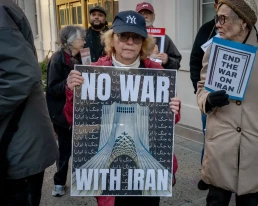
‘Stop The War on Iran’: Brooklyn Peace Activists Urge Jeffries to Help End Conflict
Take Action Now Democrats have a golden opportunity to capitalize on this issue, win big in November, and take real action on AI data centers to…

A Blue Wave Won’t Wash Away Our Oligarchy Problem
Take Action Now The massive election spending by Elon Musk and other billionaires is a huge problem, even if many of the superwealthy’s favorites…

Democrats Should Get Behind a National AI Data Center Moratorium
Take Action Now Democrats have a golden opportunity to capitalize on this issue, win big in November, and take real action on AI data centers to…

Another Way Out: Public Execution Is an Everyday Reality—Livestreamed or Not
Take Action Now For some, the Trump administration’s plan to livestream an execution was unacceptable because it wouldn’t happen behind closed doors……