Despite brutal provocation, the people of Minneapolis have been courageous and remarkably nonviolent, embodying the spirit of Martin Luther King Jr.
By David Cortright, Waging Nonviolence
The movement for justice and democracy is growing and has displayed significant political clout: mobilizing unprecedented millions in mass protest, resisting ICE attacks in Minneapolis and other cities, turning interim electoral outcomes against MAGA policies, and building pressure for National Guard withdrawals. Trump’s ratings have slumped to the lowest level of his second term. A recent poll shows a majority of Americans opposed to ICE’s aggressive tactics.
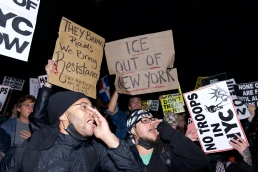
Now we are at a critical juncture, a moment of escalating risk, but also opportunity for political gain. Protests and protective actions have surged in Minneapolis, especially following the murder of Renee Nicole Good. Citizens and public officials in Minneapolis have condemned the brutality of ICE and Border Patrol operations and their blatant acts of racial and ethnic profiling. They are demanding the withdrawal of federal forces and a halt to the de facto military siege of city neighborhoods.
The White House has shown no sign of backing down and is escalating the pressure, deploying a thousand additional federal agents to Minneapolis. Another shooting incident occurred on Jan. 15. Agents followed a Venezuelan man who fled a traffic stop and shot him in the leg as he tried to run to his house. Residents and neighbors poured into the street to confront the shooter, and ICE agents fired tear gas and flash bang grenades. Amidst the chaos three grenades hit the van of a man with six children. Three of the children ended up in the hospital, including a six-month-old baby who stopped breathing after being hit by tear gas.
Anger and hatred are natural in response to such atrocities, but it is essential to avoid causing physical harm, to maintain a nonviolent intention and commitment despite increasing government provocation. A major outburst of protester violence would be disastrous, diverting attention from the message of support for victimized communities. That’s exactly what the White House is hoping for — to cover up ICE abuses, reinforce their lies about violent protesters and justify additional domestic militarization.
The protests in Minneapolis have been remarkably nonviolent so far, given the severity of ICE’s occupation and its militarized methods. Caravans of SUVs with masked agents are followed by carloads of protesters who jump out when the agents stop for an arrest and attempt to obstruct their efforts. Whistles are used constantly to sound the alarm when federal agents approach, alerting nearby residents to document and try to prevent abuses and shout for ICE to leave. More than a hundred clergy and community leaders have organized a protest and sit-in at Target corporate headquarters to demand the company end its complicity with ICE. Students have walked out of school. Restaurants have denied entry to ICE agents. Local organizers have called for a Jan. 23 day of economic blackout (no work, no school, no shopping).
Emphasizing nonviolent discipline is appropriate in the days when we commemorate the birthday of Dr. Martin Luther King Jr. He wrote, “Hatred multiples hate. Darkness cannot drive out darkness; only light can do that. Hate cannot drive out hate; only love can do that. Violence multiplies violence.”
King famously delivered a sermon titled “Loving Your Enemies.” He spoke of the spiritual power of nonviolence, but he also acknowledged the difficulty of loving those who oppress us. King addressed this dilemma in the struggle against segregation during his time. “I’m glad Jesus didn’t ask us to like our enemies,” he wrote. Respecting adversaries as fellow human beings does not mean accepting their cruel acts of racial subjugation, he argued. On the contrary, we are compelled by our love for the oppressed to take more intensive action to protect them.
The strategic dimensions of nonviolent discipline are also important. Scholar Gene Sharp emphasized that movements must be prepared to accept and withstand repression. Power never yields without a fight, and repression is common against effective movements such as ours. It is important at these moments not to back down, to maintain and intensify pressure against the oppressive adversary, while remaining disciplined.
When nonviolent movements face severe repression, the resulting suffering of victims may arouse a sympathetic response among third parties, winning support for the movement and increasing opposition to the brutality of the opponent. In this framing the government’s deployment of militarized force can be seen as a sign of weakness, of vulnerability to organized opposition.
Trump is now threatening to invoke the Insurrection Act and deploy the military. The number of armed operations has increased sharply since late December, leading to more than 2,400 arrests. ICE terror operations have escalated. In recent days residents have seen the blinding of a 21-year old man, an assault on a disabled woman trying to get to a doctor’s appointment, the beating of a Native American, the kidnapping of a 17-year-old at work, agents kneeling on a man’s neck, and a tear gas attack at a school drop off. The list of abuses seems endless and is growing. With more armed forces in the streets and public tensions mounting, the risk of additional shootings is rising.
On Friday a federal judge ordered federal agents to stop pepper spraying, detaining and pulling over peaceful protesters. This is a victory for the movement, but it will not end the immigration crackdown. As long as militarized federal agents continue to prey upon vulnerable citizens, continued resistance will be necessary.
As local residents resist ICE attacks, it is important that their actions remain rooted in nonviolent discipline, as Paul Engler and colleagues wrote regarding the resistance to the National Guard in Los Angeles. The strategic purpose of disciplined protest is to attract growing support for the movement and avoid acts that the public may see as violent and repulsive. The broader goal is to channel the growing pressure for change into effective political action for structural change.
To reap these strategic advantages, movements must display a demeanor of openness and controlled action that is attractive to potential supporters. We must show a willingness to sacrifice and maintain persistent opposition even in the face of chemical weapons attack.
The relative restraint in Minneapolis fits with the broader pattern of peaceful protest in the movement for justice and democracy and the many recent protests against ICE. MoveOn, Indivisible and other groups sponsoring the massive No Kings mobilizations last year strongly emphasized the importance of nonviolence. Protest events began with organizers giving clear instructions to participants to remain peaceful at all times and announcing the availability of training programs in nonviolent methods. (An excellent resource is the peacekeeper training handbook “Streetwise & Steady,” by Daniel Hunter and Eileen Flanagan.)
As we continue peaceful protests against government violence, we must also engage in institutional politics. The midterm electoral debates provide a space for bringing our demands into the political mainstream. Campaigning is already underway, especially for candidates in primary races. It is important for activists to show up at electoral events, demanding that candidates of both parties commit to defending democracy and ending ICE abuses.
An effective mobilization of electoral participation in the midterm elections has the potential to deliver a resounding vote of no confidence to the White House. We have a model for such an electoral rebuke in the political events of 2006, when opposition to the Iraq war was the decisive issue in turning Congress against the war, leading to legislative votes mandating the withdrawal of U.S. troops. Democrats picked up 31 seats in the House and six in the Senate, gaining full control of Congress. We have a similar opportunity now to elect candidates who will protect the vulnerable and turn the tide against Trump’s madness.
Some activists worry that Trump will cancel the elections or succeed in subverting the voting process. MAGA efforts are underway to gerrymander districts, gain control of voter lists, restrict opportunities for voting and interfere with vote counting procedures. Activists need to pay attention to these developments and work with state and local officials who manage elections to ensure the legitimacy of the voting process.
As we organize to protect the vulnerable, we must also organize to protect the vote. Electoral engagement and continued nonviolent protests are necessary to build the movement for justice and democracy and end the assault on migrant families.
Recent Posts

DOJ Whistleblower Confirms “Antisemitism” Probes Against Universities Were Sham Investigations
Take Action NowBy Democracy Now! Haley Van Erem, a former career attorney in the Justice Department’s Civil Rights Division, has filed a…
Union Members, Activists Defiant in the Face of Federal Surveillance
Take Action Now Labor leaders and union members said their solidarity with their immigrant members, and with each other, was indispensable as they…
No Coming Back From Genocide: Israel’s Global Counter-Offensive Has Begun
Take Action Now Israel knows that its so-called ‘PR problem’ is no longer that of a merely tainted image resulting from occasional negative news…

Union-Busters Are Using ICE to Intimidate California Wine Industry Workers
Take Action Now California’s wine industry runs on immigrant exploitation. Now migrant workers are unionizing.David Bacon, TruthOut In late July,…