The government funds institutions that stretch across American society. The Trump administration is demanding the relinquishment of constitutional rights to keep the money flowing.
By Amy Dru Stanley, Dissent
At a time when the Red Scare remained a palpable memory, a law professor named Charles Reich warned of government’s arbitrary power to withdraw the wealth it poured into institutions as diverse as universities, corporations, and welfare programs. “Government largess” was his term for such wealth—wealth carrying sweeping power on a “vast, imperial scale.” The flow of money, and fear of its loss, augmented the power of government “to investigate, to regulate, and to punish.” Buttressed by loyalty oaths and blacklists, largesse induced fealty and abridged civil liberties, enabling “government to ‘purchase’ the abandonment of constitutional rights.”
Today, largesse once again represents a potent form of government coercion. A devil’s bargain is on the table, with freedom up for sale—a bargain involving unconscionable conditions: losing largesse is the price paid for asserting constitutional rights. That was the lesson taught at Columbia University last month, an example of the unfreedom so worrying to Reich a half century ago. At Columbia, $400 million purchased the abandonment of a lot of academic freedom, a deal prompting some belated university repentance about ill-gotten gains and avowals of independence.
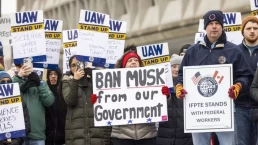
Lately, I’ve begun worrying about my own academic freedom. I’m a historian, and I teach a class on American civilization, and even aspects of American history once seen as ordinary textbook fare have become no less fraught than, say, Middle Eastern studies. The problem is that in my American civilization class students learn about ideas that may seem unworthy to the White House paymaster, who is now using the power of the purse to govern private universities as well as to control history teaching in public institutions, including the Smithsonian.
Especially subversive might seem ideas about property or equality or slavery, raising questions of justice that students explore when learning about the workings of American democracy in my class. For instance, that Andrew Carnegie favored an inheritance tax, whereby “the state marks its condemnation of the selfish millionaire’s unworthy life.” That the Supreme Court has long deemed immigrants—even when classified as “aliens” and “strangers”—as entitled to equal protection of the law. That Abraham Lincoln justified the Civil War as a divine punishment for slavery’s sins, “as the woe due to those by whom the offense came.” Such ideas belong to an American canon of moral thought but run contrary to MAGA doctrine.
Moreover, the language studied and spoken in my American civilization class is filled with words designated suspect by an official White House list—words such as “historically” and “political” and “community” and “expression” and “promote” and “men” and “women” and “equality.” For how can I teach history without saying historically? Or speak of people without saying men and women? Or ask students to think about the promise of America without invoking equality? To forbid such words means restricting knowledge of aspirations to realize the rights of American freedom.
Recent Posts

The U.S. Bombed a Wedding in Iran. It’s Not the First Time
Take Action Now The Iranian Red Crescent Society has asked the International Criminal Court to investigate the U.S. strike, saying that if the…

25 Years Ago, 9/11 Triggered a U.S. Crusade of Torture
Take Action Now But in spite of the voluminous evidence that documented high-level approval of methodical torture, not a single U.S. official went to…

Big Tech’s Debate Over “Open” and “Safe” AI Leaves Corporate Power Unquestioned
Take Action Now Two seemingly contradictory letters emerging from the AI industry point toward the same future.By Tim Scott, truthout On July 24,…
Venezuela Under Siege: What Should Progressives Do?
Take Action Now How should we respond when a government resisting US domination makes compromises that we may oppose, but does so under conditions…