
Not even water bottles and milk jugs meet standards for recyclability, a new report finds.
By Joseph Winters, Grist
No plastic is truly recyclable — not even the water bottles and milk jugs that people usually toss into their blue bins.
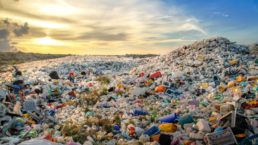
According to a new report released on Monday by Greenpeace USA, no plastic product meets a common industry standard for recyclability, even though they bear the familiar “chasing arrows” recycling symbol. The report says industry-backed recycling labels on yogurt cups, ketchup bottles, food trays, and other products perpetuate a “fiction” that recycling will ever scale up to handle the 380 million tons of plastic that companies churn out every year. The U.S. plastic recycling rate has never topped 10 percent, and a report from earlier this year revealed that it has now fallen to just 5 percent.
“Corporations are hiding behind plastics recycling and hoping that it will completely solve the plastic waste crisis that they have helped create,” said Lisa Ramsden, a senior oceans campaigner for Greenpeace USA. She called on companies to scale down plastic production and replace single-use products and packaging with reusable alternatives, like bottles that can be refilled.
Greenpeace’s report, titled Circular Claims Fall Flat Again, builds on a previous report the organization published in 2020. Back then, the group found that only certain kinds of bottles and jugs met the federal government’s definition for “recyclable” and could legally bear the chasing arrows symbol: Those bearing the numbers 1 and 2 to indicate the kind of material they’re made of, polyethylene terephthalate (PET) and high-density polyethylene (HDPE), respectively.
he same is still true today: Most recycling facilities don’t accept or recycle plastics numbered from 3 to 7, like polyvinyl chloride (PVC), polypropylene, and polystyrene because they are difficult to sort and often contaminated with toxic chemicals. But Greenpeace’s most recent report also highlighted an abysmal recycling rate for those that meet the government’s definition of recyclable, which only considers whether people have access to recycling facilities for a given kind of plastic. According to the organization’s analysis, the actual reprocessing rate for bottles and jugs made of PET (number 1) is only 21 percent, and about 10 percent for HDPE (number 2).
These numbers fall far short of an industry-backed standard from the nonprofit Ellen MacArthur Foundation, or EMF, which defines a product as recyclable only if it is recycled 30 percent of the time. Hundreds of major companies — from Clorox to the food giant Mondelez — have signed a commitment agreeing to this definition, yet their products continue to feature the chasing arrows symbol.
Although industry groups insist that plastic recycling can be improved with better collection infrastructure, Greenpeace says this is a fallacy. All plastics share similar problems: They’re extremely difficult to collect and sort, they release hazardous chemicals during the recycling process, and they are often so contaminated with toxic chemicals that they must be “down-cycled” into lower-value products, sent to a landfill, or incinerated. These challenges make plastic recycling too costly for corporations. “It’s just cheaper to buy new plastic,” Ramsden said.
Instead of doubling down on recycling, Greenpeace calls on companies to reduce their plastic packaging by at least 50 percent by 2030, either by eliminating it altogether or by replacing it with reusable materials. For example, a soft drink company could move toward the “milkman concept,” as Ramsden put it — a refillable system in which consumers return glass bottles once they’re done using them. The report also says companies should eliminate single-use plastics altogether, release annual data on their plastic packaging use and reduction rates, and push governments to adopt policies to slash plastic production, including the global plastic treaty that U.N. member states are planning to negotiate by 2024.
“Plastics recycling is absolutely not the solution” to the plastic pollution crisis, Ramsden said. As a first step, she encouraged companies to remove the recycling symbol from plastic products, since most of them are never recycled. The chasing arrows are “deceptive to consumers,” she said, “who assume that the plastic packaging they’re buying can be recycled, but it cannot be.”
Recent Posts

64 Groups to Congress: Start Preparing Tough and Effective Oversight Right Now
Take Action Now The question is not whether the public wants accountability, but whether Congress can conduct the meaningful oversight that exposes…

“Abolish ICE”: Protests Erupt in NYC After ICE Agents Shoot Father With 5-Year-Old Son in Car
Take Action Now “Candidates should seek support from the AI industry at their own peril.”By Amy Goodman, Darializa Avila Chevalier, and Carmen De…

Voters in Key States See AI Campaign Cash as More Politically Toxic Than AIPAC: Poll
Take Action Now “Candidates should seek support from the AI industry at their own peril.”By Jake Johnson, Common Dreams Polling data released…

Everything You’ve Been Told About Lethal Injection Is a Lie
Take Action Now Death by drugs is brutal—and designed for political optics. Christa Pike’s failed execution pulled back the curtain.By Arianna…